5G Meaning: What Is 5G and How Does It Work?
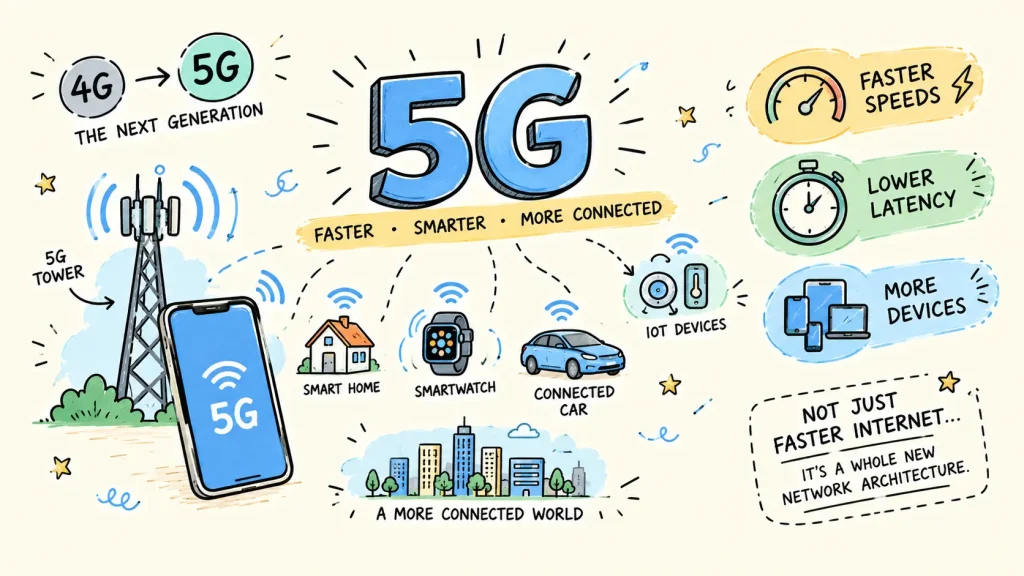
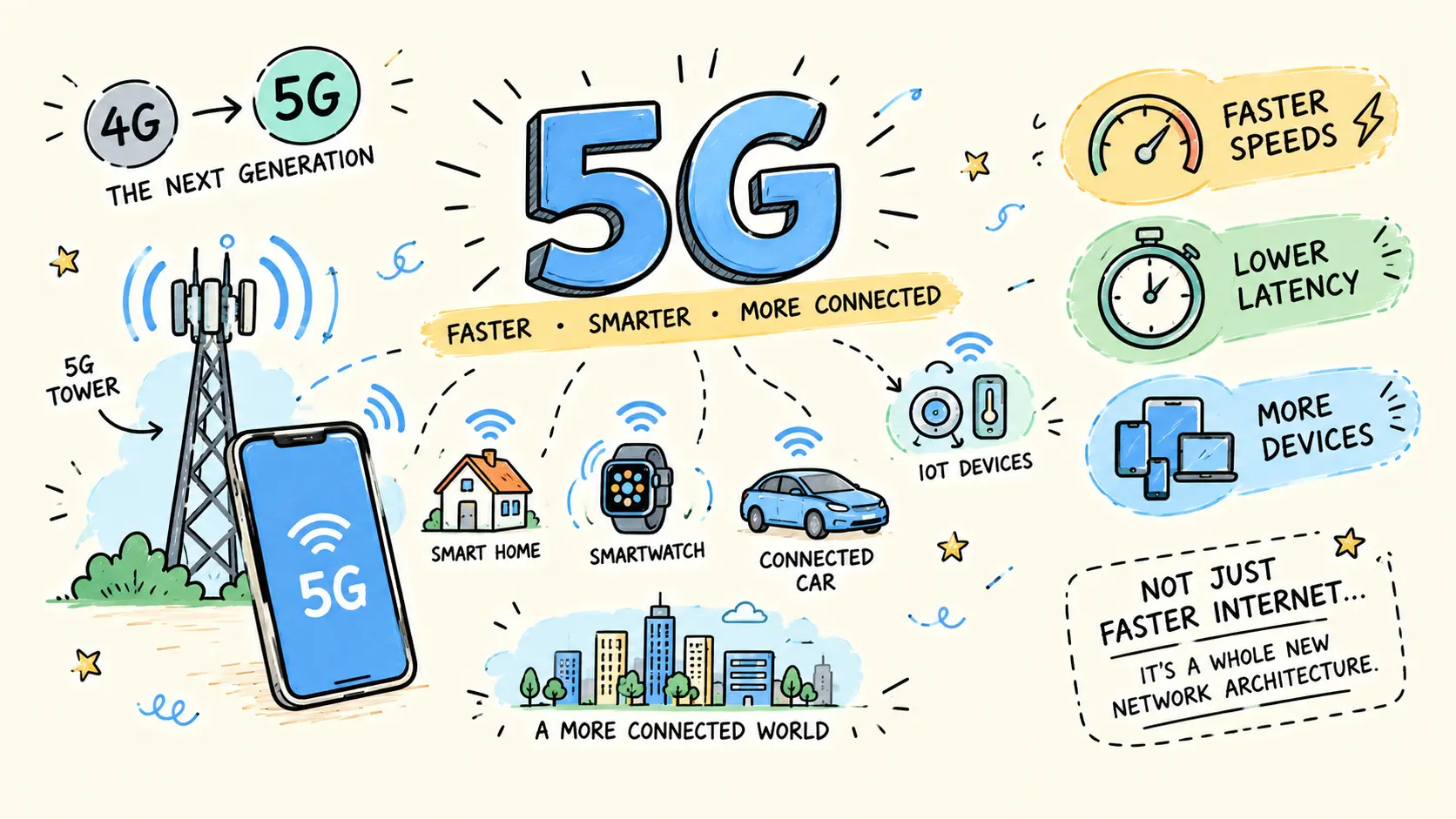
5G meaning, in short: it’s the fifth generation of mobile network technology. It delivers faster speeds and lower lag. It also connects far more devices at once than 4G ever could. It’s not just “faster internet,” though. It’s a different kind of network architecture. It’s built for a world full of smartphones, smart homes, and connected everything.
Here’s the problem. Most explainers throw out marketing buzzwords like “blazing speeds.” Others dive straight into jargon about spectrum bands. Neither one tells you what 5G means for your phone.
This guide breaks down 5G meaning in plain terms. You’ll learn what it is and how it works. We’ll also cover how 5G compares to what you already use.
What Does 5G Mean, Exactly?
5G stands for “fifth generation.” Each “G” before it marked a leap forward. 1G, 2G, 3G, and 4G each did more than the last.
Early generations moved from basic calls to texts. Later ones added streaming video and apps. 5G technology is designed to move data faster and respond quicker.
It also handles way more connected devices at once. Think about a stadium with 50,000 people. They’re all posting on social media simultaneously.
Older networks choke under that kind of load. The 5G network is built specifically to handle it. That’s the core of 5G meaning in practice.
It’s also worth separating marketing from mechanics. In other words, 5G network performance depends on more than the 5G label shown on your phone. Carriers throw around terms like “5G UW” or “5G+.” These sound impressive but describe tower types, not new services.
Looking at earlier generations helps put this in perspective. 1G brought analog voice calls in the 1980s. 2G added text messages and basic data in the 1990s.
3G introduced mobile internet browsing in the 2000s. 4G made streaming video and apps usable starting around 2010. 5G continues that pattern for today’s connected world.
The difference now is scale. A single household might run dozens of connected devices. 5G was designed with that reality in mind.That’s one reason 5G technology is designed for more than faster smartphone connections.
How Does 5G Actually Work?
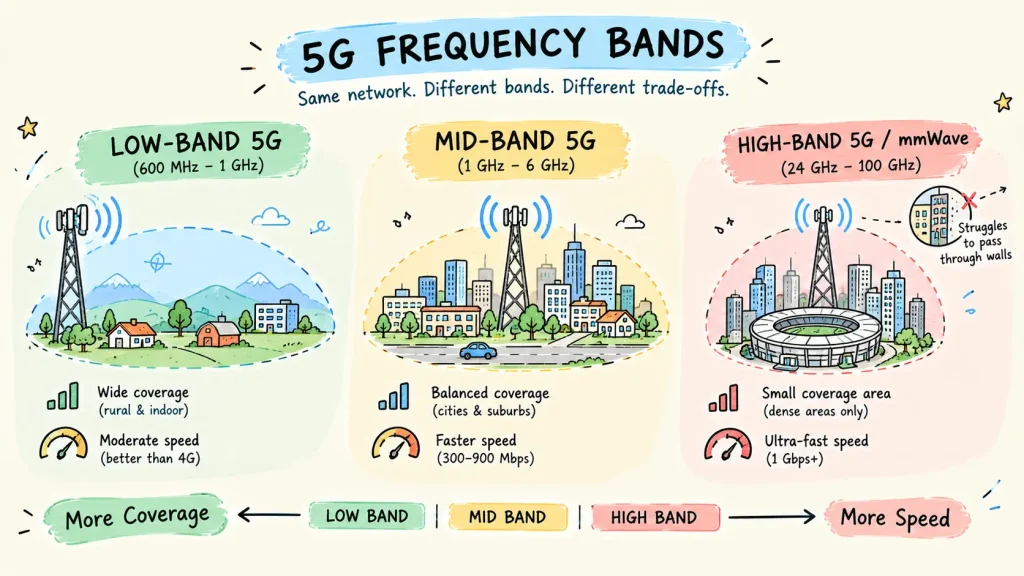
5G relies on three different radio frequency bands. Which one you’re connected to changes your experience quite a bit.
Low-Band 5G
This covers the widest area, similar to 4G towers. Speeds are only modestly better than 4G. But coverage reaches deep into rural areas and buildings.
Most “5G” you use daily runs on this band. That’s especially true outside major cities.
Mid-Band 5G
This is a middle ground between speed and coverage. Most people’s real-world 5G experience lives here. It’s noticeably faster than 4G with wide suburban and city coverage.
High-Band 5G (mmWave)
This is the headline-grabbing, ultra-fast version in commercials. Speeds can hit gigabit levels under ideal conditions. But the signal barely travels a few hundred feet.
It also struggles to pass through walls. You’ll mostly find it in dense areas. Think stadiums, airports, and city centers.
The tradeoff stays consistent across all three bands. The faster the band, the shorter its range. Carriers mix all three to balance speed and coverage.
This is why your phone’s “5G” icon can mislead you. It might show up in two different cities. Yet it can feel completely different in each one.
A carrier’s low-band 5G might cover an entire county. Their mmWave towers might only cover a few blocks. The icon alone won’t tell you which band you’re on.
The only real way to know is testing. Run a speed test and compare it. Check it against what 4G delivered in that same spot.
Carriers also don’t build out all three bands equally. Rolling out mmWave requires many towers close together. That’s because the signal doesn’t travel far.
This makes mmWave expensive and slow to expand. Low-band upgrades often reuse existing 4G infrastructure. That’s part of why low-band 5G reached rural areas faster.
5G vs 4G: What’s Actually Different?
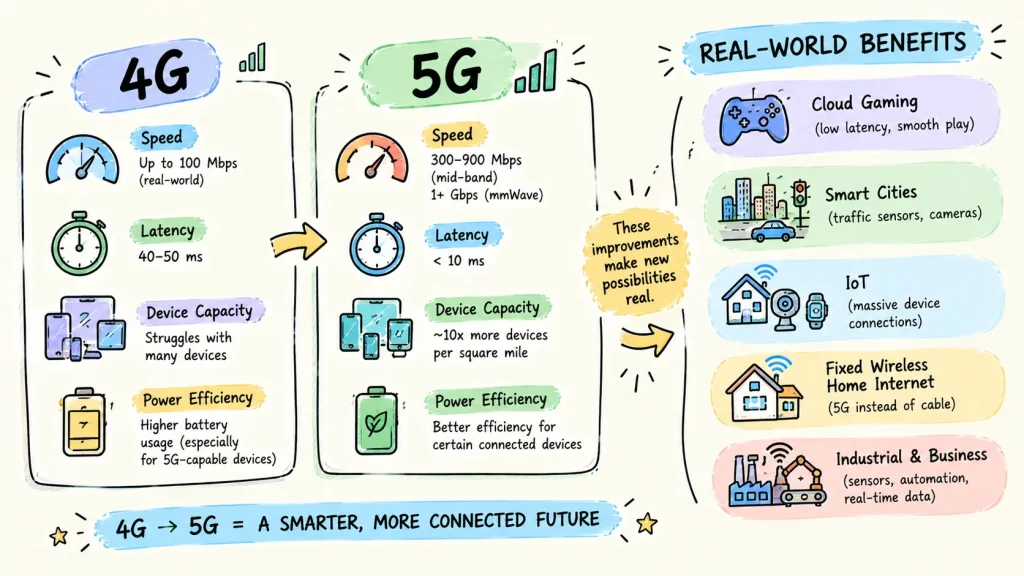
The jump from 4G to 5G isn’t just speed. Looking at 5G vs 4G shows how much more a modern mobile network can handle.
Speed: 4G tops out around 100 Mbps in real-world use. Mid-band 5G often hits 300-900 Mbps. mmWave can exceed 1 Gbps under ideal conditions.
Latency: 4G typically runs 40-50 milliseconds of lag. 5G can drop that below 10 milliseconds. That matters a lot for cloud gaming and remote devices.
Device capacity: 4G towers struggle once too many devices connect. 5G is built to handle roughly 10 times more devices per square mile.
Power efficiency: 5G networks sip less battery for certain devices. This applies especially to sensors and always-connected smart home gear.
None of this means 4G disappears overnight. Most 5G phones still fall back to 4G LTE. That handoff usually happens without you noticing.
What Can You Actually Do With 5G?
Beyond faster streaming and quicker downloads, 5G opens new doors. Here’s what becomes practical that wasn’t before.
- Cloud gaming without noticeable input lag, since low latency matters more than raw speed here.
- Remote surgery and telemedicine trials, where doctors need near-instant feedback from robotic tools.
- Smart city infrastructure, like traffic sensors and cameras that need to talk constantly.
- Fixed wireless home internet, which uses 5G towers instead of cable lines for broadband.
- Massive IoT deployments, like warehouses full of sensors tracking inventory in real time.
Most people will just notice faster app loading. They’ll also notice smoother video calls day to day. The bigger structural benefits show up more in industries.
You’re less likely to feel the warehouse-sensor use case personally. A factory manager, on the other hand, would notice it immediately.
Do You Need a New Phone for 5G?
Yes. 5G requires a dedicated modem chip. Older phones simply don’t have this hardware built in.
If your phone released before roughly 2019, it’s likely 4G-only. Buying a new 5G phone doesn’t guarantee better speeds, though.
Coverage depends heavily on your carrier’s local buildout. A new 5G phone in a low-band-only zone won’t feel dramatically different from solid 4G.
It also helps to check your carrier’s coverage map first. Most carriers publish these online by band type. Comparing your address against low-band, mid-band, and mmWave maps sets realistic expectations before you buy.
Trade-in and upgrade programs can offset the cost, too. Many carriers offer credits when you switch to a 5G plan. It’s worth asking before assuming a full-price upgrade is necessary.
Common Misconceptions About 5G
A few myths keep circulating. It’s worth clearing them up here.
“5G is available everywhere now.”
Coverage is expanding fast. But true mid-band and mmWave 5G still lag behind low-band in rural reach.
“5G will replace home broadband entirely.”
Fixed wireless 5G is legitimate in some areas. It’s not yet a universal replacement for cable or fiber.
“More bars means faster 5G.”
Signal strength and actual speed aren’t the same thing. You can have full bars on a slow low-band connection.
“5G phones drain battery too fast to use.”
Early 5G phones did struggle here. Chipset efficiency has improved a lot since then.
Once you understand what is 5G and how its different frequency bands work, those confusing claims become much easier to evaluate.
“5G” gets used as a catch-all term. That happens regardless of which band powers your connection.
Understanding the band behind the icon helps set expectations. It also helps you troubleshoot slow speeds. If your “5G” feels like 4G, you’re probably on low-band.
FAQ
What does 5G actually stand for?
5G stands for fifth generation. It refers to the fifth major generation of mobile network technology.
Is 5G faster than 4G?
Yes, in most cases. Mid-band and high-band 5G offer significantly faster speeds and lower latency.
Does 5G use more battery than 4G?
It can, especially when a phone hunts for signal. Many phones now let you toggle 5G off.
Is 5G safe?
Major health organizations, including the World Health Organization, have found no confirmed health risk. This applies at the exposure levels used in public networks.
Do I need a 5G plan to use a 5G phone?
Most modern carrier plans include 5G access automatically. Still, check with your carrier, since some budget plans cap you at 4G.
The Bottom Line
5G meaning boils down to this: a network built to move more data. It moves that data faster, to more devices, with less delay than 4G.
Whether you notice a dramatic difference depends on your location. It also depends on which band your carrier has built out nearby.