Is 5G Better Than LTE? What You Need to Know
Is 5G better than LTE? In most cases, yes, especially for speed and lag. But LTE still offers wider and more consistent coverage in many areas. Which one actually serves you better depends a lot on your location and how you use your phone.
Carrier marketing pushes 5G as an automatic upgrade. It rarely mentions where LTE still holds a real advantage.
This guide breaks down is 5g better than lte in practical terms. You will learn exactly when each one wins.
What Is the Real Difference Between 5G and LTE?
LTE, short for Long Term Evolution, is the technology behind most 4G LTE networks. It has been the mobile data standard for over a decade. It is stable, widely available, and well understood by every major carrier.
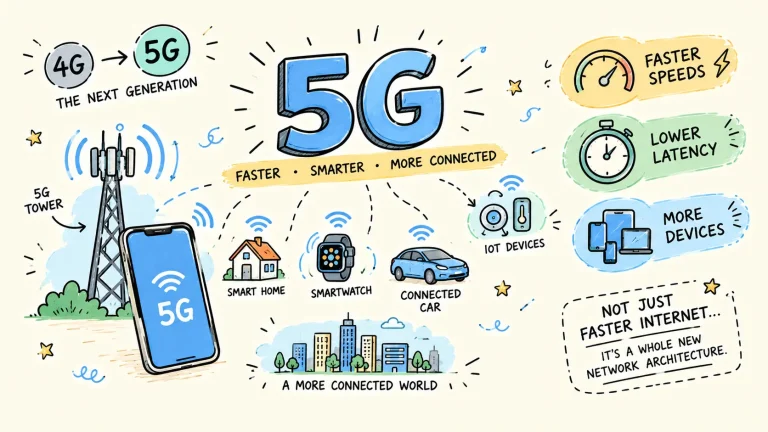
5G is the newer generation built for speed and capacity. It uses different radio frequency bands than LTE does. Those bands allow faster data transfer and lower lag.
The core difference is not just speed though. 5G was designed to handle far more connected devices at once. LTE simply was not built with that kind of scale in mind.
Is 5G Faster Than LTE?
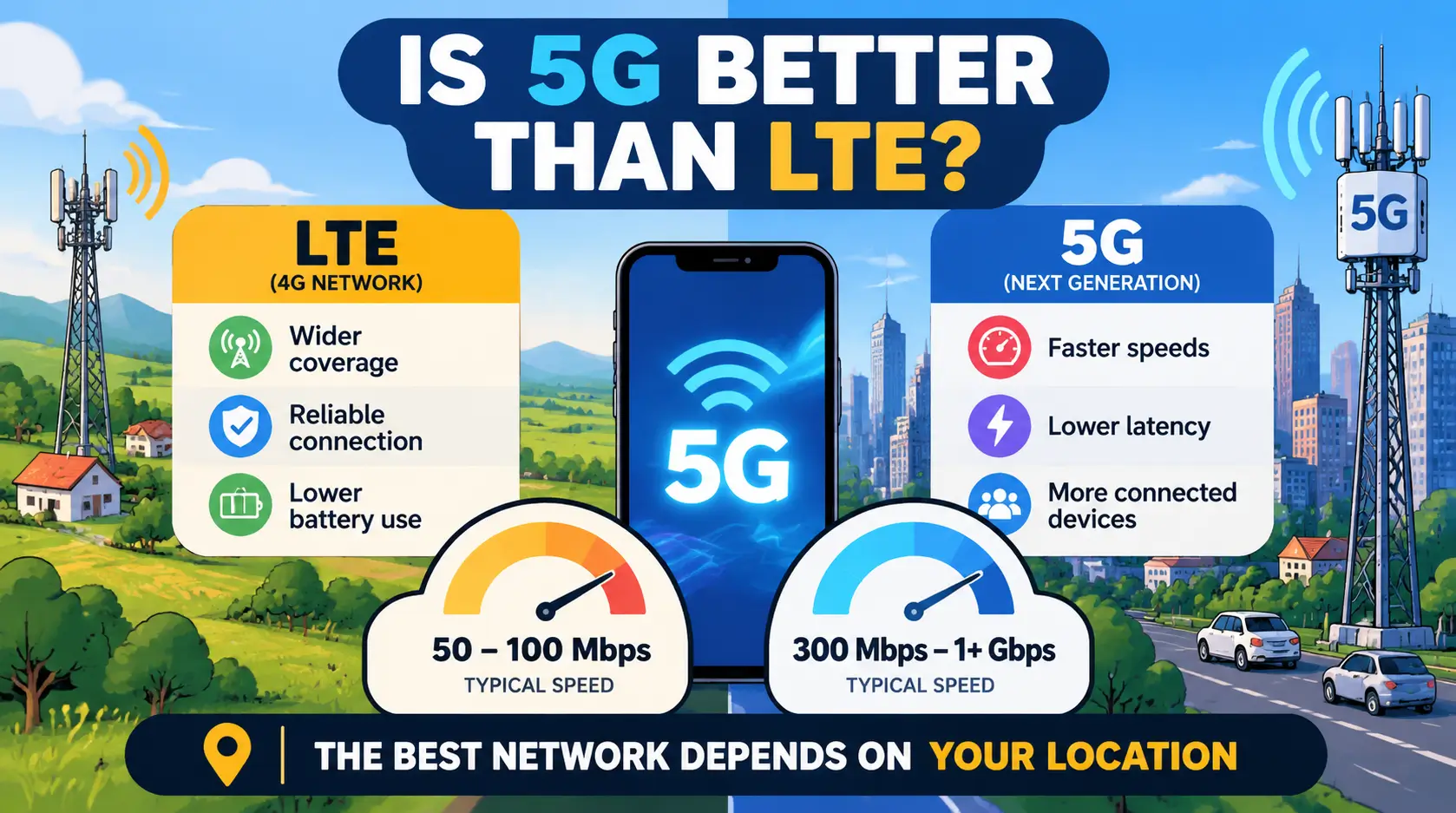
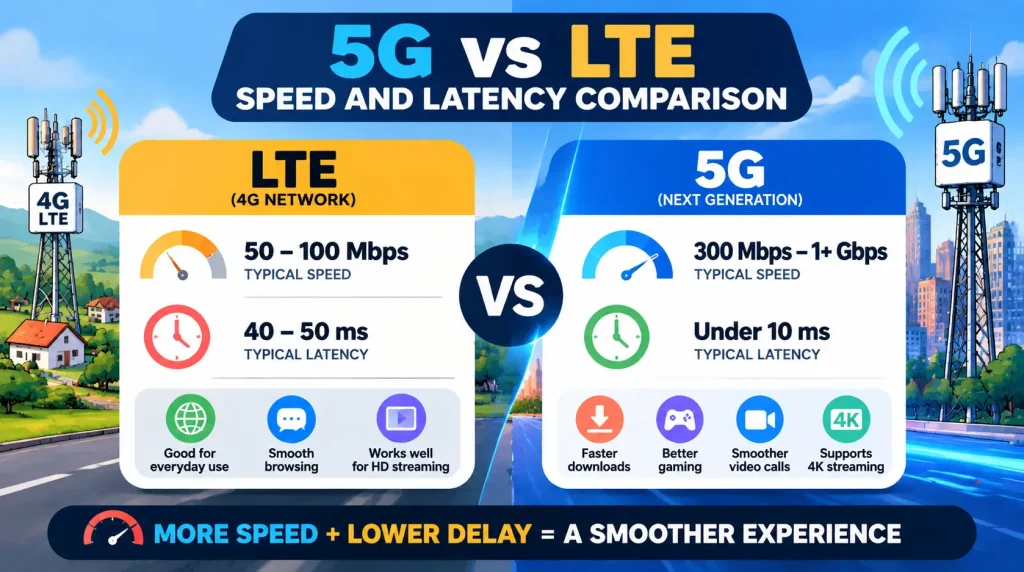
Is 5g faster than lte in real conditions? Yes, in most everyday situations. LTE typically tops out around 50 to 100 Mbps for the average user. 5G can go well past that depending on the band involved.
Mid-band 5G commonly delivers 300 to 900 Mbps under good conditions. High-band 5G, known as mmWave, can exceed 1 Gbps. That is a dramatic jump over typical LTE speeds.
Low-band 5G tells a different story though. It is only modestly faster than LTE in many areas. 5G speed depends heavily on which specific 5G band you are actually using.
Is 5G Better Than LTE for Latency?
Yes, and this is where 5G shows its clearest advantage. LTE typically runs 40 to 50 milliseconds of lag. 5G can drop that below 10 milliseconds under good conditions.
This matters more than most people realize on a daily basis. Lower latency means faster app response and smoother video calls. It also helps enable things like real-time cloud gaming.
For casual browsing this difference is barely noticeable. For gaming or video calls it becomes a lot more obvious. The gap widens even further on high-band 5G specifically.
Does LTE Still Have Better Coverage Than 5G?
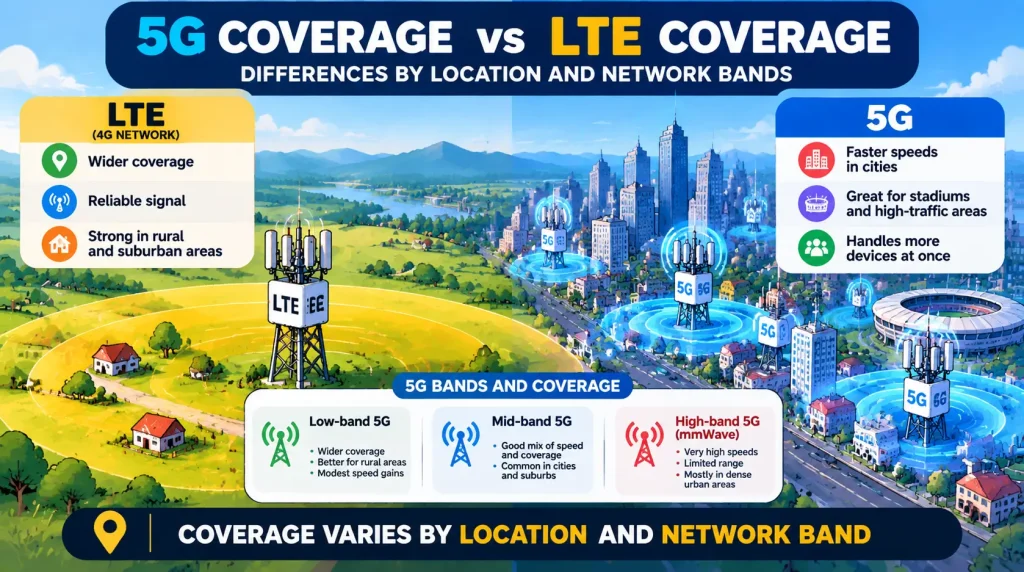
Yes, in many regions LTE coverage remains more consistent. Carriers spent over a decade building out LTE infrastructure nationwide. 5G rollout, especially for the faster bands, is still expanding.
Low-band 5G covers rural and suburban areas reasonably well by now. But mid-band and high-band 5G remain concentrated mostly in cities. Rural users often rely on LTE more than urban users do.
This is a key reason 5G does not always feel faster in practice. If your area only has low-band 5G, LTE might perform very similarly. Coverage maps from your carrier reveal the real picture here.
It is worth checking your specific address, not just your city overall. Coverage can vary block by block in some areas. A quick speed test at home settles the question fastest.
Does 5G Drain Battery Faster Than LTE?
This was a bigger issue in early 5G phones. Constantly searching for a 5G signal used up extra power. Chipset efficiency has improved a lot since those first models launched.
Modern 5G phones handle the technology much more efficiently now. Most people will not notice a dramatic battery difference today. Still, phones in weak 5G coverage areas may drain slightly faster than usual.
If battery life is a major concern some phones let you toggle 5G off. This forces the phone onto LTE, which can help preserve battery in certain situations.
This toggle is usually buried in your network or connection settings. Testing both modes for a day or two shows the real difference. Some phones show noticeably better battery life on LTE alone.
Is 5G Better Than LTE for Streaming and Downloads?
Generally yes, especially for large file downloads. 5G’s higher speeds noticeably cut download times for big files. Streaming in higher resolutions also benefits from the extra available bandwidth.
That said LTE already handles standard video streaming just fine. Most streaming services do not actually require 5G level speeds for smooth playback. The real advantage shows up more with 4K content or large downloads.
When LTE Might Actually Be the Better Choice
5G is not automatically the right choice for everyone. Here is when LTE still makes practical sense.
You live in a rural or low coverage area. LTE often provides more reliable service in these regions. 5G coverage may be spotty or unavailable entirely.
Your phone does not support 5G. Older phones simply cannot access 5G networks at all. LTE remains the only realistic option for these devices.
Your data usage is mostly texting and browsing. These tasks do not require 5G level speeds at all. LTE handles light usage comfortably with no noticeable downside.
You are trying to preserve battery life. In weak signal areas toggling to LTE can help. This reduces the power drain from constant 5G signal searching.
When 5G Is Clearly Worth It
5G becomes the better option under a few common conditions. Here is when it makes a real difference in daily use.
You live in a city with strong 5G coverage. Mid-band and high-band 5G offer real and noticeable speed improvements here. Downloads and streaming both benefit quite a bit.
You do a lot of video calls or gaming. Lower latency makes both feel noticeably smoother. This matters more than raw speed for real time interaction.
You frequently download large files on the go. Faster speeds cut wait times considerably for big downloads. This adds up a lot over regular daily use.
You are in a high traffic area like a stadium or airport. 5G handles many simultaneous connections better than LTE. Congestion issues that plague LTE become far less common.
5G vs LTE: Quick Comparison
| Factor | LTE | 5G |
| Typical speed | 50 to 100 Mbps | 300 Mbps to 1+ Gbps, varies by band |
| Latency | 40 to 50 ms | Under 10 ms in good conditions |
| Coverage | Wider and more established | Expanding, uneven by band |
| Battery impact | Generally lower | Improved, but can vary by phone |
| Best for | Rural areas, light use | Cities, streaming, gaming, large downloads |
This is really a 5g vs 4g question at its core, since LTE is the main technology behind most 4G networks in use today.
Common Misconceptions About 5G vs LTE
A few myths keep circulating on this topic. It is worth clearing them up here.
“5G is always faster than LTE.” Not always true. Low-band 5G can perform very similarly to solid LTE in some areas.
“5G has replaced LTE completely.” Not yet. Most 5G phones still rely on LTE as a fallback whenever 5G is not available.
“5G coverage means fast 5G everywhere.” A 5G icon on your phone does not tell you which band you are on. Speed varies a lot between low-band and high-band connections.
“Switching to 5G always improves your experience.” If your area only has weak 5G coverage, LTE might actually perform better. Checking real speed tests matters more than the icon alone.
FAQ
Is 5G better than LTE for everyday phone use?
For most everyday tasks, yes, though the difference is often small. Texting and browsing feel very similar on both networks.
Is 5G worth upgrading for if I mostly use LTE now?
It depends heavily on your area’s 5G coverage. Check your carrier’s coverage map before assuming 5G will feel noticeably faster.
Does 5G cost more than LTE on most carrier plans?
Usually not. Most modern carrier plans include 5G access at no extra cost. Older or budget plans may still cap you at 4G.
Can I switch back to LTE if 5G is not working well?
Yes. Most phones let you disable 5G directly in network settings. This forces the phone to use LTE instead.
Will LTE eventually be phased out completely?
Eventually, yes, though this will take years to fully happen. Carriers are gradually shifting more infrastructure toward 5G over time.
The Bottom Line
Is 5g better than lte really comes down to your location and how you use your phone. For speed, latency, and heavy data use, 5G usually wins in strong coverage areas. For rural coverage or light everyday use, LTE still holds its own just fine.
Check your carrier’s coverage map before assuming 5G is automatically the better choice. The right network depends entirely on where you actually spend your time.