What Is Freelance Writing? Beginner’s Guide to Big Earnings
Freelance writing is the work of writing content for clients on a contract basis instead of being a traditional employee. You choose your projects, set your rates and work wherever you have an internet connection. The global market for independent content creators hit $7.6 billion in 2025 and is growing at 8.1% per year, so yes – it’s a real career path, not a side-hustle fantasy.
Everyone is saying this is a get-rich-quick scheme or starving artist trap. The truth is, it’s not either. It is a real business that takes real work, but the barrier to entry is lower than most think. You do not need a journalism degree. You don’t need 10 years of experience. You need to be able to write well, meet deadlines, and find people who will pay you to do both.
This guide covers what the job really is, what an independent creator does, how much you can realistically earn, and how to begin without quitting your day job.
Is This Career Actually Legit?
Yes. This is a real profession with real income data behind it.
According to the US Bureau of Labor Statistics, there are 135,400 writers and authors in the entire country, a good many of whom are self-employed. According to ZipRecruiter, the average salary for independent content creators in 2026 is $48,412 per year while Glassdoor has the average salary at $81,564. The big difference comes from the fact that general content creators make an average of $22 per hour, but specialized professionals in the finance, medical or technical niches can ask $44-$49 per hour or more.
Here is the part most gurus skip: 91% of full-time independents in their first year earn less than $30,000. That is not a scam. That is a business with a learning curve. The people who stick with it, build a niche, and treat it like a business – not a hobby – are the ones who cross into sustainable income.
What Does an Independent Writer Do?
An independent creator creates written content for clients who need it but don’t have the time or talent to create it themselves. You are not a worker; You’re a free agent. You pitch, negotiate, create, revise and invoice.
The work comes in many formats. Most entry level work consists of blog posts and articles. Sales pages, ads, email campaigns – copywriters write it all. Technical writers create manuals and how-to guides to help explain complex information. Ghostwriters are paid to write books, articles, and speeches that are published under other peoples names. Scriptwriters write scripts for podcasts and YouTube. Email marketers build newsletter sequences and onboarding sequences.
Most independents produce a few types of content with some frequency, especially when they are just getting started. The trick is not to try to master it all at once. The trick is to start off with one type, get good at it then expand.
How Does This Business Work?
The mechanics are simpler than most beginners expect.
You find a client who needs content. You agree on a scope, deadline, and price. You create the piece. You submit it. You invoice. You get paid. Then you repeat.
Clients come from all over. Some get jobs on websites like Upwork or Fiverr. Some use LinkedIn as a way of pitching directly to companies. Many start with their own network – friends, family, former colleagues who own businesses and need content. The most successful independents eventually build a stable of 3 to 4 repeat clients that give them steady work month after month.
There are three main ways that pricing works. Charging by the hour is easy, but it limits your earnings because you’re exchanging your time for cash. Efficiency is rewarded with per-project pricing – do it faster and make more per hour. Retainer agreements provide predictable monthly income and are often a good sign of good, long-term client relationships. Most newbs go from per project rates and build up to retainers as trust is built.
How Much Can You Really Earn?
Technical writers create manuals and how-to guides from complicated information.
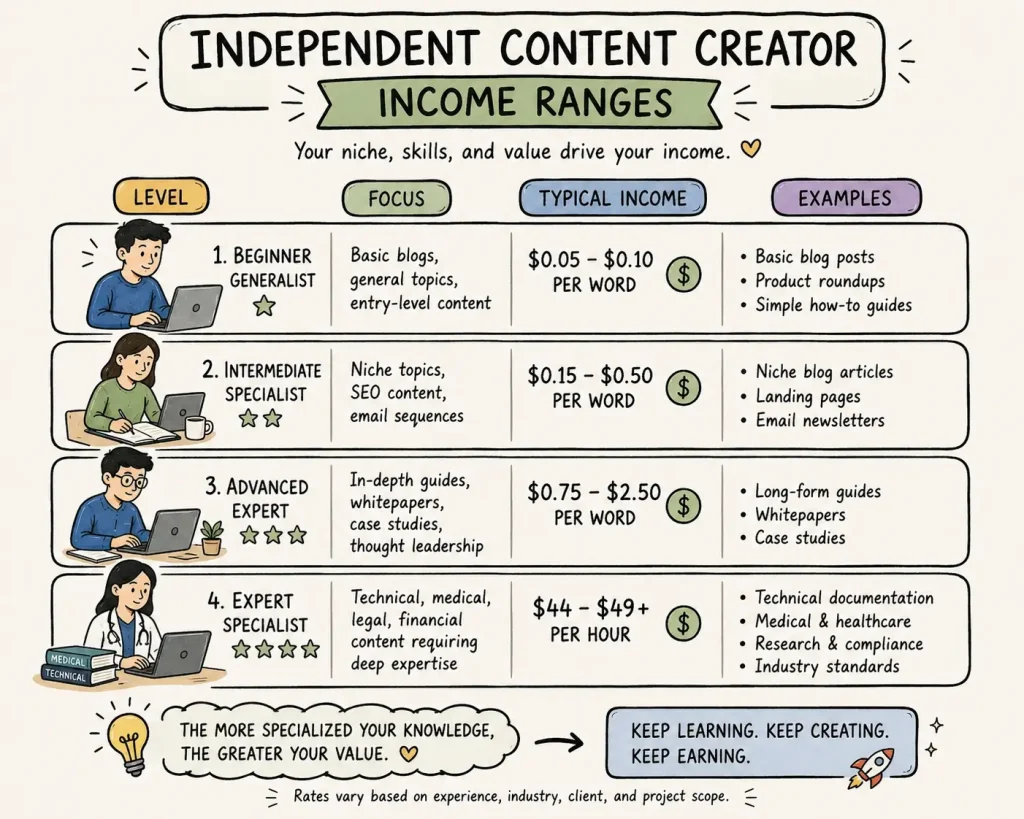
New creators mostly start at around $0.05 to $0.10 per word, so a 1000-word article is $50 to $100. At that rate, producing 15 articles a month makes $750-$1,500. This isn’t “quit your job” money but it is real income while you learn.
As you specialize, rates climb. Finance authors average around $73,000 per year. White paper specialists can earn $6,000+ a month. Medical authors charge $60 to $150 an hour. The story is the same: general content pays less because it is commoditized. Specialized work pays more because it carries business risk and requires expertise that artificial intelligence can’t replicate.
Same story with the market data. Upwork content projects dropped 32% year over year in 2025, but independents working on AI-related projects made 44% more per hour. Clients are going straight to AI for cheap, undifferentiated copy. Clients still pay top dollar for human writers who understand their industry and want content that ranks, converts and builds authority.
What About AI?
AI has changed this industry, but it has not killed it.
Generic blog posts and commodity content are indeed vanishing. Companies can do that in-house with free access to chatgpt. But 84% of companies still outsource content, and the ones that pay well want something AI cannot deliver: subject-matter expertise, original research, strategic thinking, and brand voice.
A University of Copenhagen study of 25,000 workers found that AI’s productivity impact was underwhelming for most businesses – the majority saw only about 3% time savings. Companies that went all-in on AI content are now discovering they still need humans who can think, not just type.
The creators who thrive in 2026 are the ones who use AI as a tool – for research, outlines, and first drafts – but add the judgment, creativity, and industry knowledge that software lacks. Think of AI as a faster keyboard, not a replacement for your brain.
How to Start: Your First 30 Days
You do not need a website. You do not need business cards. You need three samples and the courage to send your first pitch.
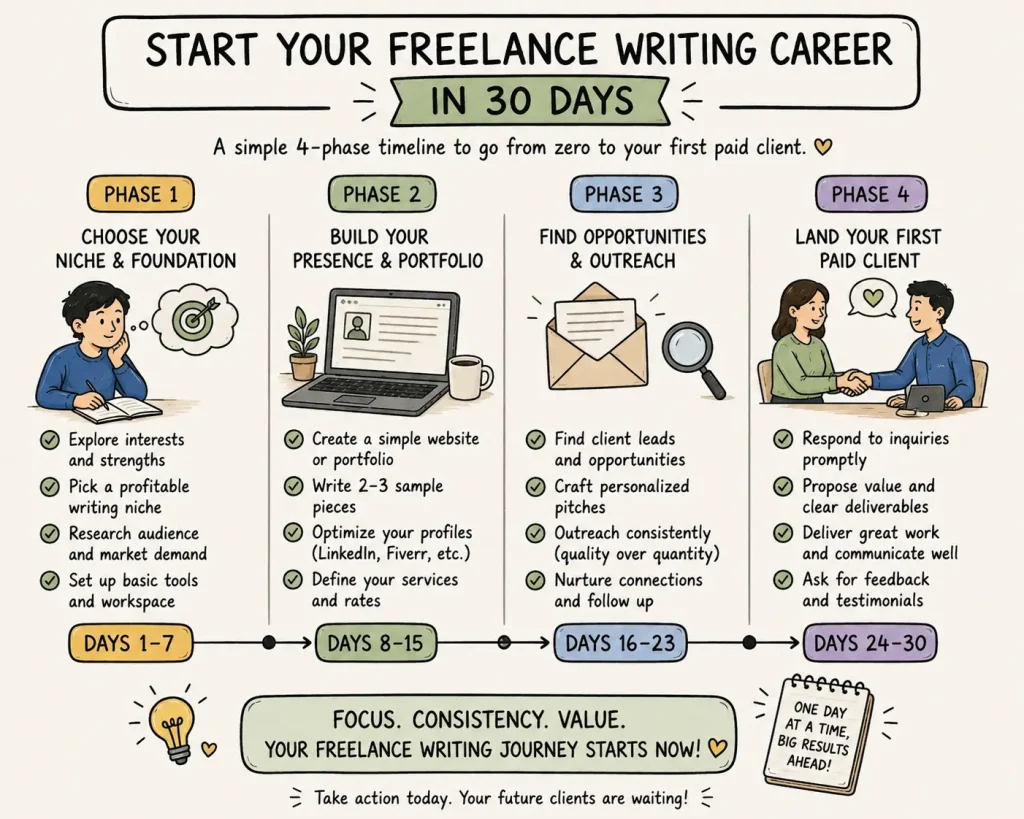
Day 1-7: Pick a niche. Do not write things about everything. Pick an area you know a bit about and have a real interest in – health, finance, technology, lifestyle, or SaaS. Write three sample pieces, each 800 to 1,000 words, in that niche. Publish on Medium, LinkedIn or a free WordPress Blog.
Day 8 to 14: Build a simple portfolio. To get started, you need a one-page Google Doc with links to your samples, a 50-word bio and your contact information. You don’t have to spend weeks perfecting a website.
Day 15 to 21: Pitching time. Send 5-10 personalized pitches a day. Seek out small businesses, startups and niche blogs that publish frequently. Keep pitches brief Introduce yourself and mention a specific piece of content they’ve created. Pitch one article idea that would work for their audience.
Days 22-30: Get your first client. Your first gig might be $50. That’s fine. The point is not to make money. The aim is to get a testimonial, portfolio piece and proof that a person will pay you to make content. From there you raise your rates with every new client.
FAQ
What is freelance writing?
Freelance writing is the practice of writing content for clients on a contractual basis instead of as a traditional employee. You set your own rates, decide which projects to work on, and work independently, often juggling several clients at once.
Do I need a degree to become an independent writer?
No. Clients want to see your samples and that you can meet deadlines, not your diploma. A degree in English or journalism can help, but is not required. Your resume is not as important as your portfolio.
How long does it take to make a living from freelance writing?
Most people take 6 to 12 months to build up consistent income. The first 3 months are usually the hardest. Low pay, rejected pitches, slow client responses. If you treat it like a business, pitch every day, and specialize in a niche, you will generally cross over to full-time income quicker than someone who creates content about everything for everyone.
Can I do this part-time while working a full-time job?
Yes and that’s the way most successful independents start out. You should aim to write 2 to 3 articles a week in the evenings or on weekends to build up your portfolio and client base without the financial stress of diving in headfirst right away.
Is this still worth it with AI around?
Yes, but the game has changed. Generic content creators are struggling. Those who combine writing skill with industry expertise, SEO knowledge, or strategic thinking are in higher demand than ever. AI is a tool, not a replacement, for professionals who bring real value.
Final Thoughts
This career is not a lottery ticket. It is a business you build one client, one article, and one pitch at a time. The people who succeed are not necessarily the most talented. They are the most consistent.
Start with one niche. Write three samples. Send ten pitches. Land one client. Do that for 30 days, and you will know whether this path fits you. The only wrong move is waiting for permission to begin.