
Bodyweight Squats for Beginners: Form, Benefits & Routine
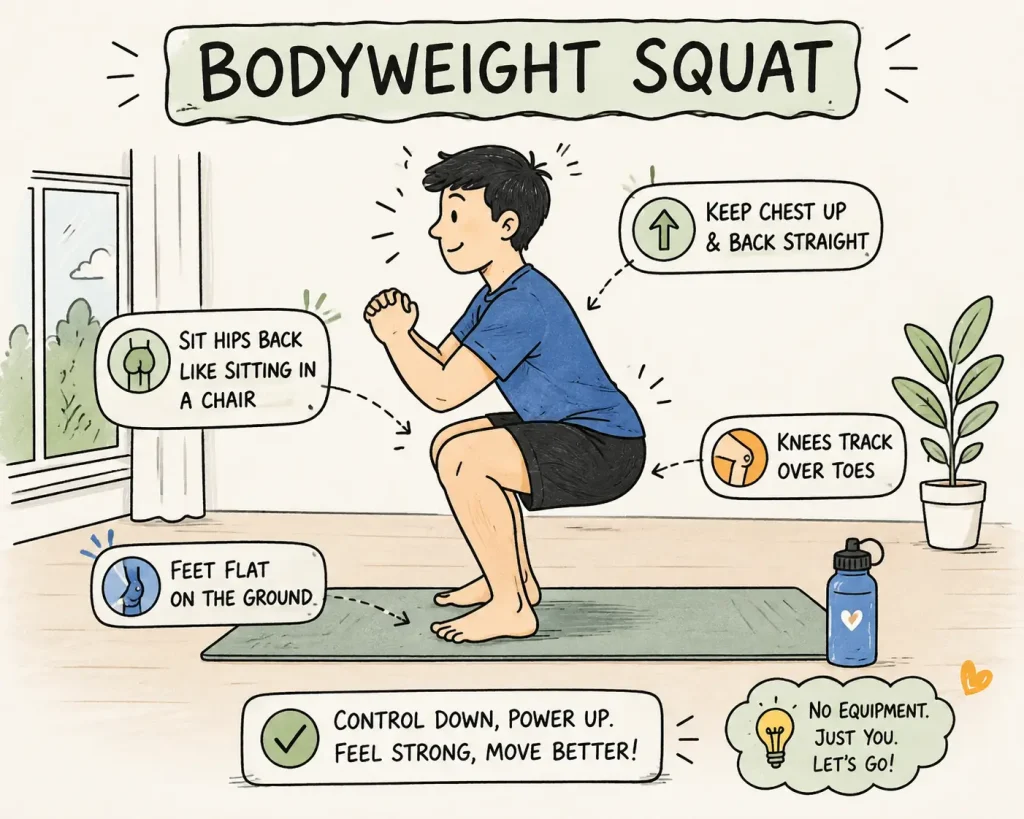
A bodyweight squat is a foundational lower-body exercise performed with no equipment – just your body and a small amount of floor space. Done correctly, it strengthens the quads, glutes, hamstrings, and core while improving balance and making everyday movements easier.
Ask ten people to name one exercise they can do with zero gear. Most will say squats. And they’re right.
No gym. No weights. Just your body.
But here’s what most people miss. A bodyweight squat looks easy, so beginners rush it. They get the form a little wrong – not “hurt on day one” wrong, but more like sore knees a week later, or no real results. So let’s slow down and do it right.
This guide covers what a bodyweight squat is, the muscles it works, how to do one correctly, the mistakes to avoid, and a simple home routine you can start today.
What Is a Bodyweight Squat?
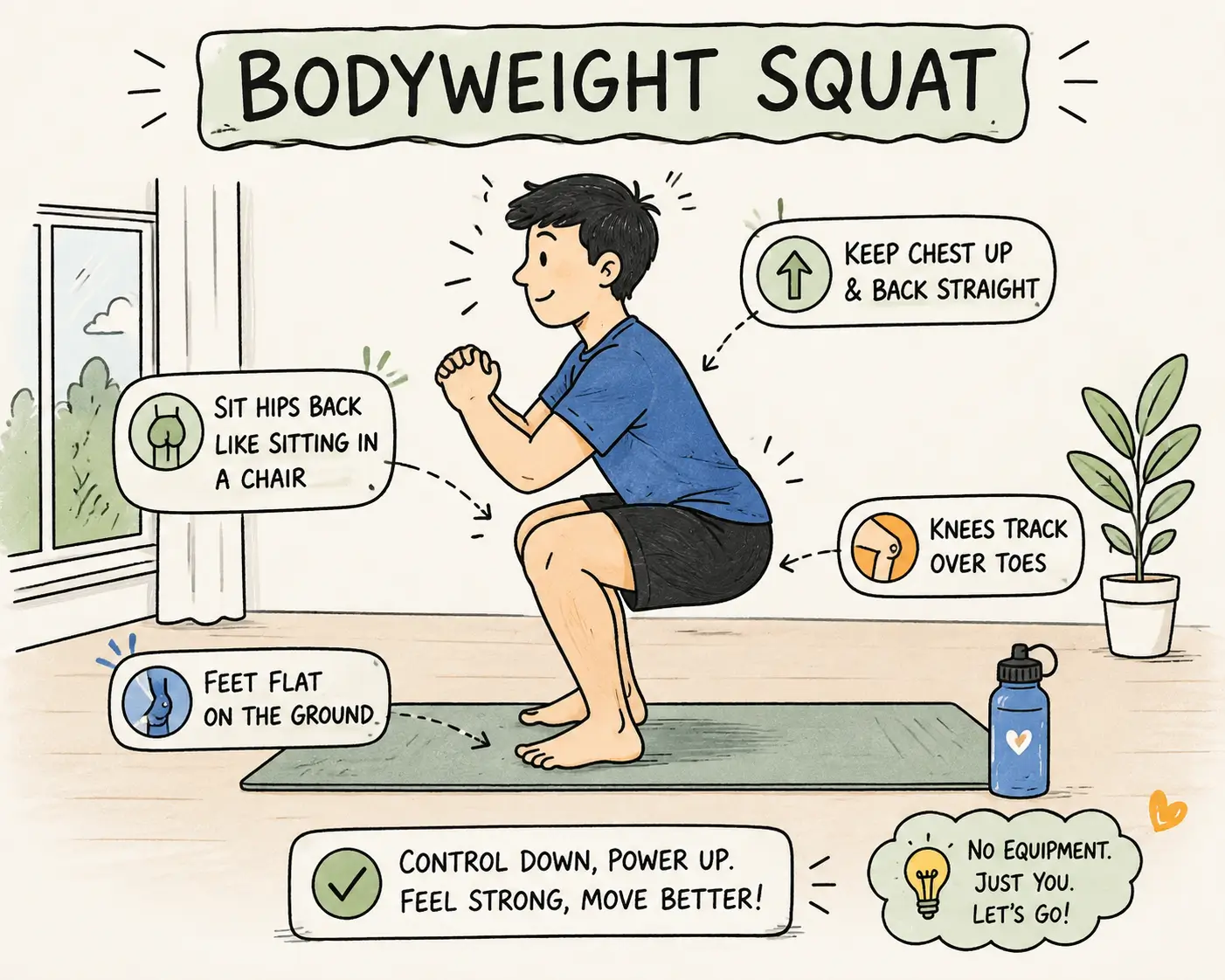
A bodyweight squat is a squat performed with no added weight – no barbell, no dumbbells. You lower your hips down and back as if sitting into an invisible chair, then stand back up. That’s one rep.
Simple. That’s the point. It’s one of the best foundational moves for beginners because the body already knows the pattern – you perform a squat every time you sit down, stand up, or pick something up off the floor.
Which Muscles Do Bodyweight Squats Work?
Bodyweight squats are a full lower-body exercise, not just a quad movement. A single squat engages:
- Quads (front of the thighs) – the primary movers
- Glutes – engage hard on the way up
- Hamstrings (back of the thighs) – control the descent
- Core (abs and lower back) – stabilize the spine throughout
- Calves – assist with balance
Working this many muscle groups in one movement makes squats especially efficient for anyone short on time.
Benefits of Bodyweight Squats
Why do squats get so much attention? A few solid reasons:
- Stronger legs and glutes with no equipment required
- Improved functional movement – stairs, chairs, and carrying loads all become easier
- Calorie burn from engaging large muscle groups
- Better balance and stability, which matters more with age
- Location-free – bedroom, kitchen, hotel room, anywhere works
Not a bad return for a move that costs nothing.
How to Do a Bodyweight Squat (Step by Step)
Take it slow the first few times. Good form now protects your knees later.
Breathe. Inhale on the way down, exhale on the way up.
Stand tall. Feet about shoulder-width apart. Toes pointed slightly outward.
Lift your chest. Look straight ahead. Relax your shoulders.
Initiate with the hips. Push them back first, as if reaching for a chair behind you.
Lower down. Bend your knees until your thighs are roughly parallel to the floor. Only go as low as feels comfortable.
Keep your heels down. Weight stays in the heels, not the toes.
Drive back up. Push through the heels and squeeze your glutes at the top. That’s one rep.
Common Mistakes Beginners Make
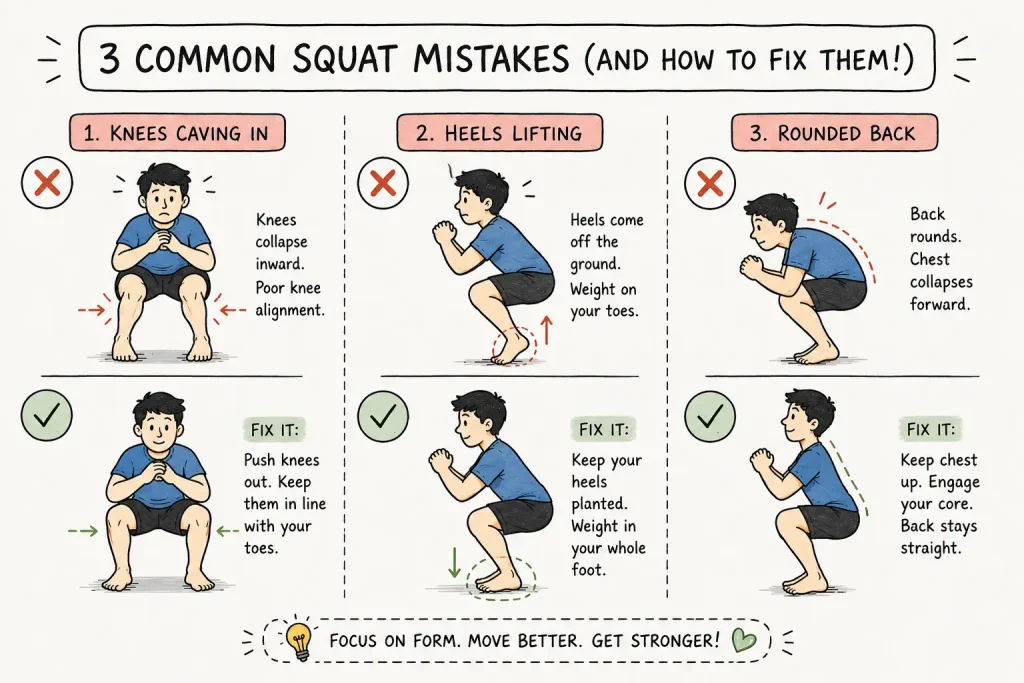
Common Bodyweight Squat Mistakes to Avoid
These errors trip up nearly everyone. Catching them early protects the knees and improves results.
- Knees caving in. Push the knees gently outward so they track over the toes.
- Heels lifting off the floor. This signals forward lean or tight ankles – slow down and shift weight back.
- Rounding the back. Keep the chest up and spine neutral. No hunching.
- Going too deep too fast. A shallow squat with good form beats a deep squat with a bent back. Depth improves with time.
- Rushing the movement. Control is the goal, not speed.
Bodyweight Squat Variations to Try
Once the basic squat feels natural, these bodyweight squat variations keep progress moving and target the legs from new angles.
| Variation | Why Try It | Difficulty |
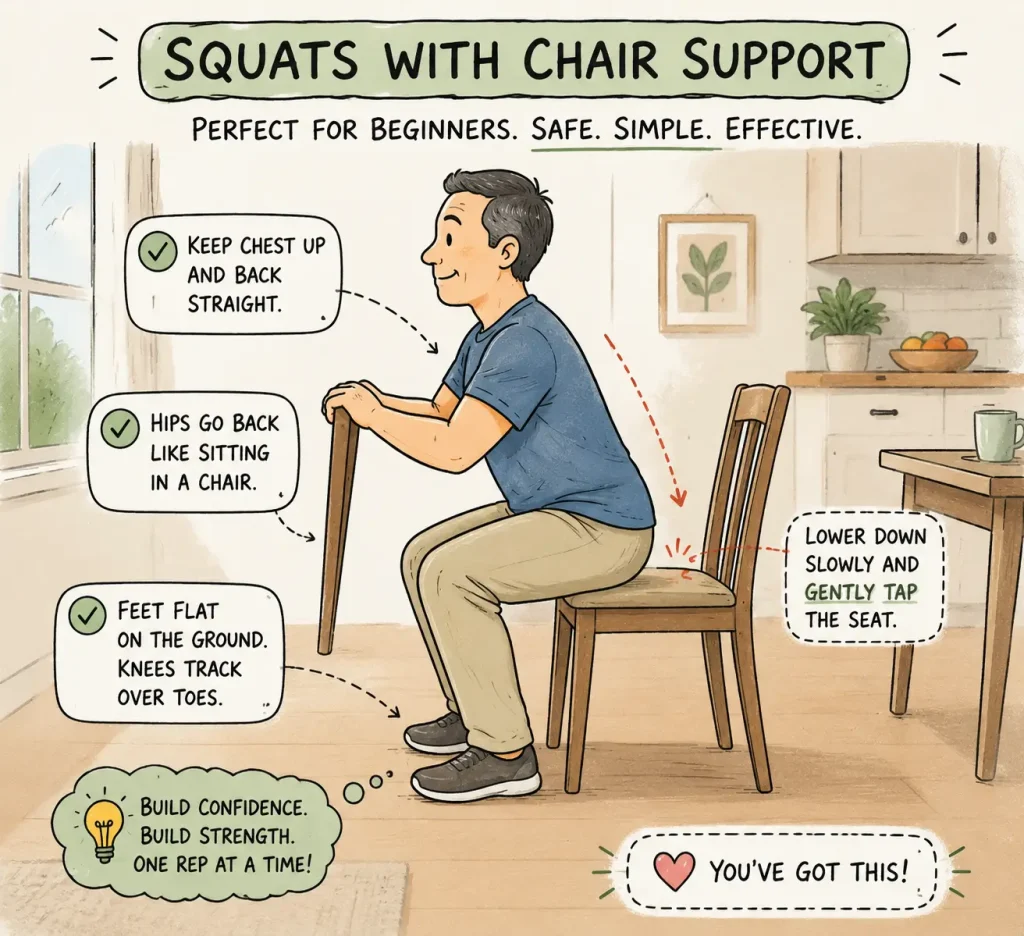
| Chair squat | Great for beginners – tap a chair each rep for guidance | Easy |
| Sumo squat | Wider stance targets the inner thighs | Easy |
| Pause squat | Hold 2 seconds at the bottom for added burn | Medium |
| Jump squat | Adds cardio and explosive power | Hard |
New to squatting? Start with chair squats and sumo squats. Save jump squats for when the legs feel genuinely strong.
A Simple Beginner Home Routine
No hour-long sessions needed. Here’s a structured starting point. For a more complete lower-body plan, this routine pairs well with other calisthenics exercises from a Beginner Bodyweight Workout guide.
- Weeks 1-2: 3 sets of 10 chair squats. Rest 60 seconds between sets.
- Weeks 3-4: 3 sets of 12 regular bodyweight squats.
- Week 5+: 3 sets of 15. Then introduce sumo squats or pause squats.
Aim for three sessions per week with a rest day between each. That’s genuinely enough to start noticing a difference – no need to train daily.
How Often Should You Do Bodyweight Squats?
Three times per week is the recommended starting frequency. Muscles don’t grow during a workout – they grow during rest and recovery. According to the CDC, adults should perform muscle-strengthening activities at least twice per week, not daily. Squatting every day, especially as a beginner, typically leads to excess soreness rather than faster results – and significantly increases the chance of quitting early.
Note: This article provides general fitness information, not medical advice. Anyone with an existing injury, knee problems, or a relevant health condition should consult a doctor or qualified trainer before starting.. Got an injury, dodgy knees, or any health condition? Have a word with a doctor or trainer before you jump in.
Frequently Asked Questions
Q: Are bodyweight squats enough to build leg muscle?
For beginners, yes. Bodyweight alone provides sufficient resistance to stimulate leg muscle growth at the start. As squats become easier, increasing reps, slowing the tempo, or progressing to harder variations – such as pause squats or single-leg squats – keeps the muscles challenged.
Q: How many bodyweight squats should a beginner do per session?
Around 30 reps per training day is a solid starting point – structured as 3 sets of 10. Clean form takes priority over volume; hitting large rep numbers with poor technique is counterproductive.
Q: Do bodyweight squats burn belly fat?
Squats do not burn fat from one specific area – spot reduction is not supported by evidence. However, squats engage large muscle groups and burn a meaningful amount of energy, which contributes to overall fat loss when combined with a reasonable diet.
Q: Can bodyweight squats replace the gym?
Bodyweight exercises can count as muscle-strengthening activity when they challenge your muscles enough. Over time, adding resistance – such as a loaded backpack or resistance band – or progressing to single-leg variations extends the challenge further.
Q: My knees hurt when I squat. What’s going wrong?
In most cases, knee discomfort during squats is linked to form errors – particularly knees caving inward, heels lifting, or descending too deep too soon. Slowing the movement, keeping weight in the heels, and reducing depth typically resolves the issue. If pain persists, consult a doctor or physiotherapist before continuing.
Q: What’s the difference between a chair squat and a regular bodyweight squat?
A chair squat uses a seat behind the person as a depth guide and safety cue, making it ideal for total beginners or those with limited mobility. A regular bodyweight squat removes the chair and requires more balance and hip control. Chair squats are better suited for those new to the movement, while regular squats work best once basic form is established.
Final Thoughts
No fancy gym is required to build strong legs – bodyweight squats are proof of that. Get the form right, ease in gradually, and show up three days a week. Give it a month. The difference in how the legs feel will be noticeable.
Master this one movement and there’s a foundation in place for almost any home workout – from cardio to building muscle at home without any gym equipment. Clear some floor space. Do the first proper set today. A future self breezing up a flight of stairs will be glad you did.