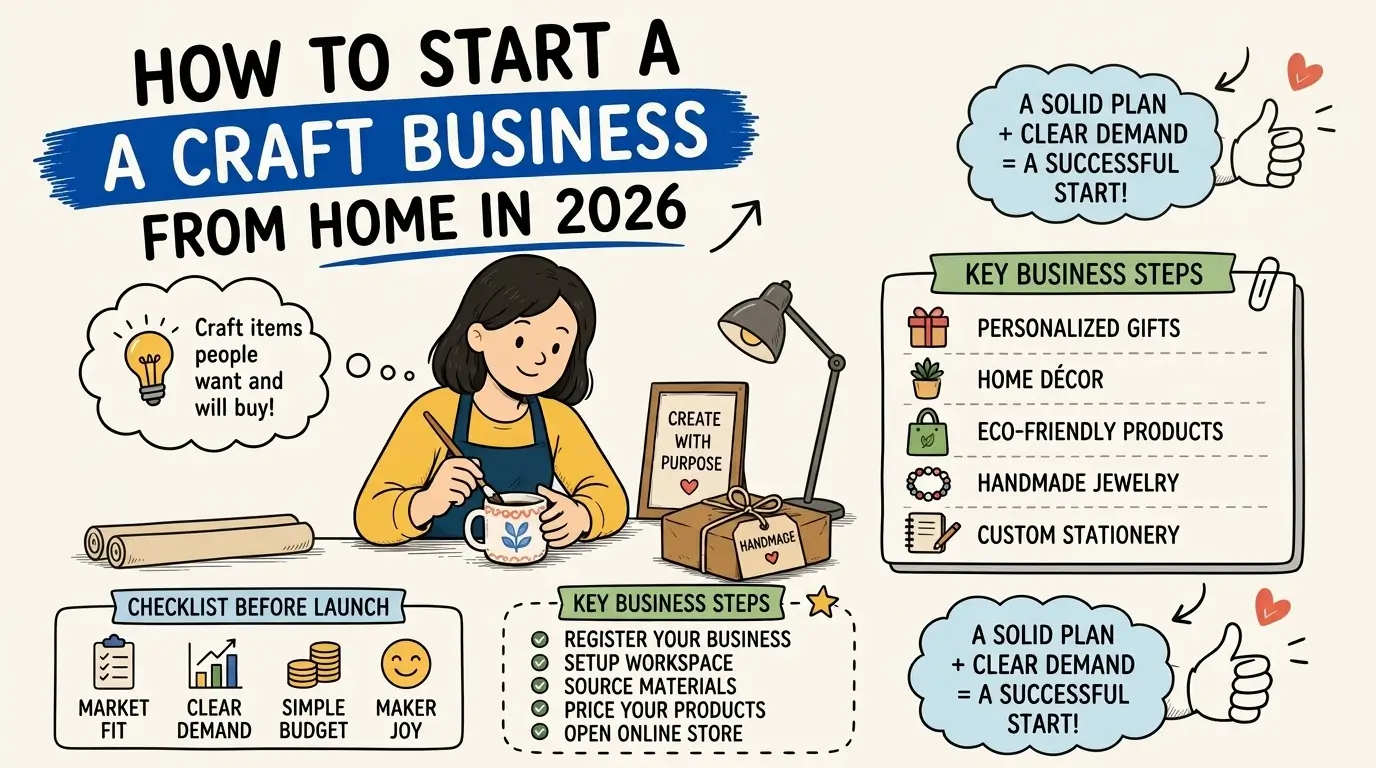
How to Start a Craft Business From Home in 2026
Most craft businesses don’t fail because the products are bad. They fail because the maker spent three months building inventory before finding out if anyone would actually buy it.
To start a craft business, prove people will pay for your product before you invest in inventory. Price your work to cover materials, labor, and profit, not just materials. Pick one sales channel to start with, then let your first real customers tell you what to build next.
Most beginners trying to figure out how to start a craft business get that order backwards. They buy supplies, make a dozen items, design a logo, and only then go looking for buyers. It feels like progress. It isn’t – it skips the one step that decides whether the business survives its first year.
Prove Demand Before You Spend on Supplies
A hobby gives you total freedom. You make whatever looks fun, and you switch directions whenever you feel like it. Selling adds a constraint – the product now has to make sense to someone who isn’t you.
Take handmade candles. “I sell candles” tells the buyer almost nothing. “I make personalized candles for weddings and anniversaries” gives the product an audience, an occasion, and a reason to exist. The candle itself might barely change. How a stranger sees it changes completely.
Before spending real money, ask yourself a few things. Can you make this consistently? Who actually buys it? Can you charge enough to make the time worthwhile? Can you reproduce it without starting from scratch every time?
That last one trips people up. A detailed wall hanging might sell for $150, but if each piece takes twelve hours, scaling gets nearly impossible fast. A product that works has to make sense for the buyer and for the person making it – not just one or the other.
Compliments from friends feel nice, but they aren’t proof of demand. Better signals show up where money is already changing hands – marketplace listings, reviews on similar products, local craft fairs, repeated requests in comment sections. A comment like “I wish this came in another size” is a clue about a gap in the market, not just a passing remark.
You don’t need fifty finished pieces before launch. Make three to five strong samples, photograph them well, and show them to real potential buyers. Watch which one gets questions and which one gets scrolled past. Does someone ask the price before you bring it up? That’s usually a good sign.
Choosing Craft Business Ideas With Actual Demand
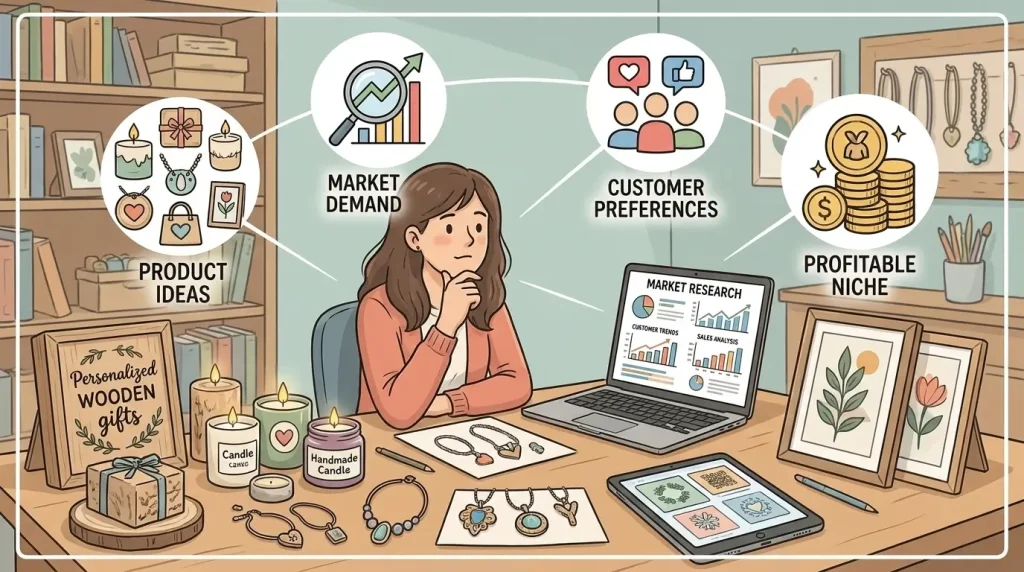
There’s no fixed list of crafts guaranteed to make money. Profit depends on the buyer, your production cost, competition, and how clearly the product is positioned. Still, some craft business ideas give beginners more room to test and grow than others.
| Product Type | Likely Buyer | Possible Angle |
| Personalized gifts | Birthday and wedding shoppers | Names, dates, custom messages |
| Handmade candles | Gift and home décor buyers | Wedding favors, seasonal scents |
| Jewelry | Style-conscious shoppers | Minimalist, custom, occasion-based |
| Art prints | Homeowners and renters | Nursery, office, local themes |
| Digital designs | Creators and small businesses | Templates, invitations, printable art |
The broad category rarely matters as much as the angle. “Jewelry” is saturated. “Minimalist birthstone necklaces for new mothers” gives a specific person a reason to stop scrolling. “Printable art” is generic; “printable nursery art for woodland-themed rooms” tells someone exactly why it’s for them.
The best craft business ideas usually come from the overlap between three things – something you can make well, something buyers already value, and something you can produce at a profit. That intersection is where an idea turns into a real opportunity.
Trends deserve caution. They create quick spikes in demand but can fade before your next batch of supplies even arrives. A more reliable test: does the product still make sense once the trend fades? Seasonal colors come and go. A genuinely useful gift category tends to keep selling.
Your offer should be explainable in one sentence, too. “We make personalized wedding keepsakes from recycled wood” works instantly. “I make different things depending on what inspires me” is forgettable, even when the work itself is good. Starting narrow doesn’t box you in forever – it just gives customers something clear to remember you by.
Pricing Handmade Products Without Working for Free
Pricing handmade products is where a lot of talented makers accidentally turn a promising business into an unpaid hobby. Someone spends six hours on a piece, feels awkward charging for their own time, and prices it based on materials alone.
Say a candle costs $7 in wax, fragrance, wick, and container, plus $2 in packaging. Now add the time spent making it, marketplace fees, the occasional failed batch, and shipping supplies. Selling that candle for $12 brings in revenue – it just doesn’t leave much behind once real costs are counted.
A workable starting formula: materials plus labor plus business expenses plus profit equals selling price. It isn’t perfect, because no single formula fits every handmade product, but it forces you to count costs beginners typically forget – materials, packaging, payment and marketplace fees, labels, advertising, equipment wear, and your own time.
A busy shop can still lose money. That’s a hard lesson to learn after a hundred orders instead of before your first one. Building a profitable craft business means knowing your real costs before trying to increase sales.
There will almost always be someone selling something similar for less. Let them. Chasing the lowest price traps you in thin margins and constant production. Competing on design, personalization, quality, or a sharper niche tends to hold up better over time, which is really what separates a profitable craft business from one that just stays busy.
Legal requirements vary depending on what you sell and where you’re located. In the United States, the Small Business Administration’s guide to registering your business is a solid starting point before you accept any payments. Some categories carry extra regulatory weight – if you’re making cosmetics, soaps, or anything applied to skin, the FDA’s cosmetics guidance is worth reading directly, since the rules for these categories are more specific than most beginners expect.
How to Sell Crafts and Find Your First Customers
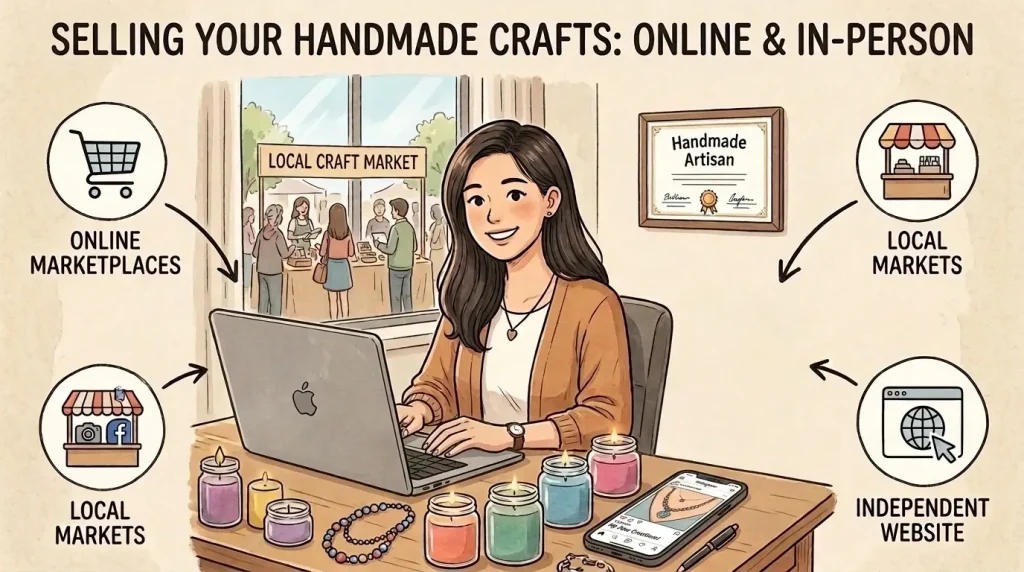
If you’re learning how to sell crafts, you don’t need five sales channels running in week one. That’s usually a fast way to spend more time managing accounts than actually selling anything.
| Selling Channel | Best For | Main Challenge |
| Online marketplace | Reaching people already shopping | Competition and platform fees |
| Social media | Visual products and maker stories | Building consistent attention |
| Local markets | Products people want to touch | Event costs and limited dates |
| Own website | Brand control and repeat customers | Generating your own traffic |
Marketplaces are often one of the easiest ways to sell crafts online, mostly because visitors already intend to buy something.Social media tends to work best when the making process itself is interesting to watch – a short video of raw materials turning into a finished piece often beats another polished product photo.
Local markets shouldn’t be dismissed either. Screens can’t replicate texture, scent, or a short conversation with the person who made the item. That matters a lot for ceramics, textiles, candles, and similar goods.
If you’re still narrowing down what to make in the first place, our guide on business ideas for beginners with no clear direction yet walks through how to find a starting point.
Chasing viral reach is the wrong early goal when you’re figuring out how to sell crafts. It’s tempting, sure. But your first ten real buyers will teach you more than ten thousand views ever will. They tell you whether your product descriptions actually make sense to someone who isn’t you. Whether the packaging survives shipping instead of arriving cracked. Whether anyone liked it enough to come back and order again.
So talk to those early customers. And skip the obvious question – “do you like it?” gets you a polite yes almost every time. Ask what almost stopped them from ordering instead. Ask what confused them on the product page, or what would’ve made them recommend it to a friend without hesitating. Those answers are usually more useful than a month of guessing on your own.
A Simple 30-Day Plan for Your First Collection
You don’t need three months of logo revisions before anyone sees what you’ve made. A focused first month is usually enough to tell you whether an idea deserves more time and money.
In week one, research buyers and competitors instead of branding – study similar products, read reviews, get specific about who your likely customer is. In week two, turn that research into a small collection and work out real pricing. Week three is where the business meets the public: take clear photos, publish the listings, start talking about them, and don’t expect every item to perform equally. Week four is for adjusting based on what actually happened, not what you assumed would happen going in.
One product that genuinely sells teaches you more than twenty products nobody has ever seen.
Frequently Asked Questions
How do I start a craft business with very little money?
Begin with materials you already own where possible, and launch a small collection instead of a large one. Test whether people will actually pay for the product before investing in bulk inventory. The early goal is proof of demand, not a fully stocked shop.
What are the most profitable craft business ideas?
Profit depends more on margins, production time, and clear demand than on the category itself. Personalized gifts, custom décor, jewelry, and digital products tend to perform well when aimed at a specific type of buyer rather than a broad audience.
How many products should I make before launching?
There’s no exact number, but three to five strong products are usually enough for an early test. A small, focused collection is easier to photograph, price, and explain than a large catalog of unrelated items.
How do I sell crafts online as a complete beginner?
Pick one main selling channel, take clear photos, and explain what makes each item useful or different. Early feedback from real customers usually matters more than being present on every platform at once.
How long does it typically take for a craft business to make money?
There’s no fixed timeline. Pricing, production costs, audience size, and consistency all affect results, so it’s more realistic to treat the first few months as testing and adjustment rather than expecting steady income right away.
How to Start a Craft Business: The Real Starting Point
Learning how to start a craft business isn’t really about supplies, logos, or picking the perfect platform first. It starts earlier than that, with proof that someone outside your circle wants what you make and is willing to pay enough for it to be worth your time.
Find a specific customer. Test a small collection. Price the work properly. Then pay close attention to what real buyers tell you, because that feedback matters more than any plan you make in advance.
Your first goal doesn’t need to be replacing a salary. It can be something smaller and more useful – getting one stranger to happily pay for something you created. Then doing it again.