Bodyweight Bicep Exercises: Effective Home Arm Workout
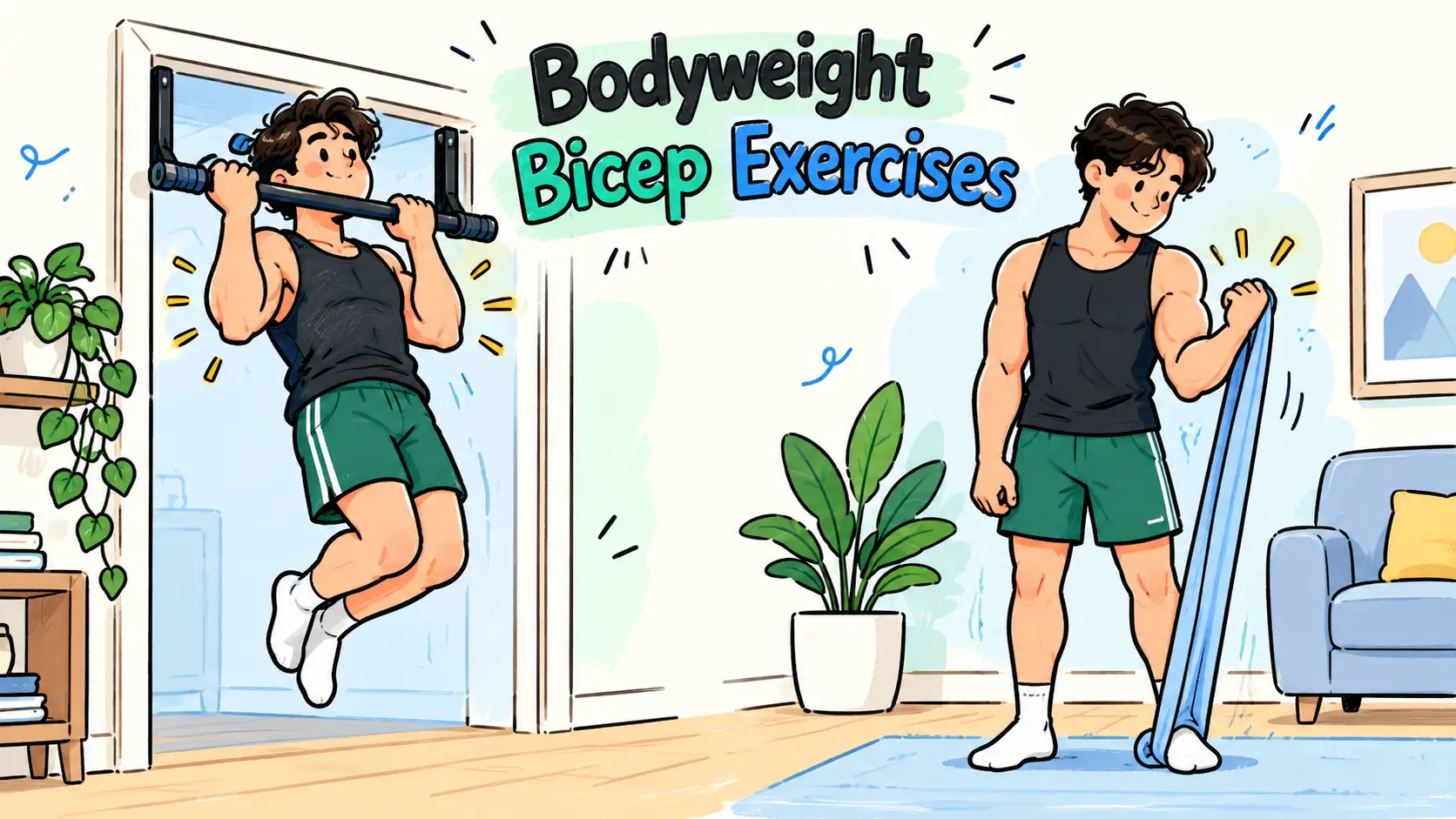
Bodyweight bicep exercises like chin-ups, doorway curls, and towel curls build real strength. They use your own body weight as resistance. Household objects work too, no dumbbells required.
Biceps are harder to isolate without equipment than chest or legs. Unlike many bodyweight arm exercises But with the right angles, you can still make them work hard. Tension tricks matter more than fancy gear.
Here’s the problem. Most “no equipment arm workout” articles recycle the same three moves. Others quietly assume you own resistance bands.
Neither approach helps if you have nothing but a doorframe. This guide covers real bicep exercises without weights that actually work. You’ll also learn tension tricks using things you already own.
Why Biceps Are Tricky Without Weights
Biceps are a “pulling” muscle. Most classic bodyweight moves are pushing movements instead. Push-ups, dips, and planks barely touch them.
That’s the core challenge with bodyweight bicep exercises. You need something to pull against. Without that, your biceps stay undertrained.
The solution comes down to three strategies. Pull your own body weight, like with chin-ups. Or create resistance using household objects, like a towel.
You can also use isometric tension tricks. These require no object at all. Just your own opposing muscle force.
The Best Bodyweight Bicep Exercises
1. Chin-Ups
The single best bodyweight bicep exercise, hands down. An underhand grip shifts more work onto your biceps. This beats a standard overhand pull-up for arm focus.
- Grip the bar with palms facing you, hands shoulder-width apart.
- Pull your chin above the bar, keeping elbows close to your body.
- Lower slowly – the eccentric portion is where growth happens.
Can’t do a full chin-up yet? Use a chair to assist partway. Or try slow negatives instead.
Jump to the top position first. Then lower yourself down as slowly as possible. This still builds real strength over time.
Grip width changes the emphasis too. A narrower underhand grip shifts even more tension onto biceps. Try alternating grip widths every other session.
This keeps the muscle adapting instead of plateauing. Small variations make a real difference over weeks.
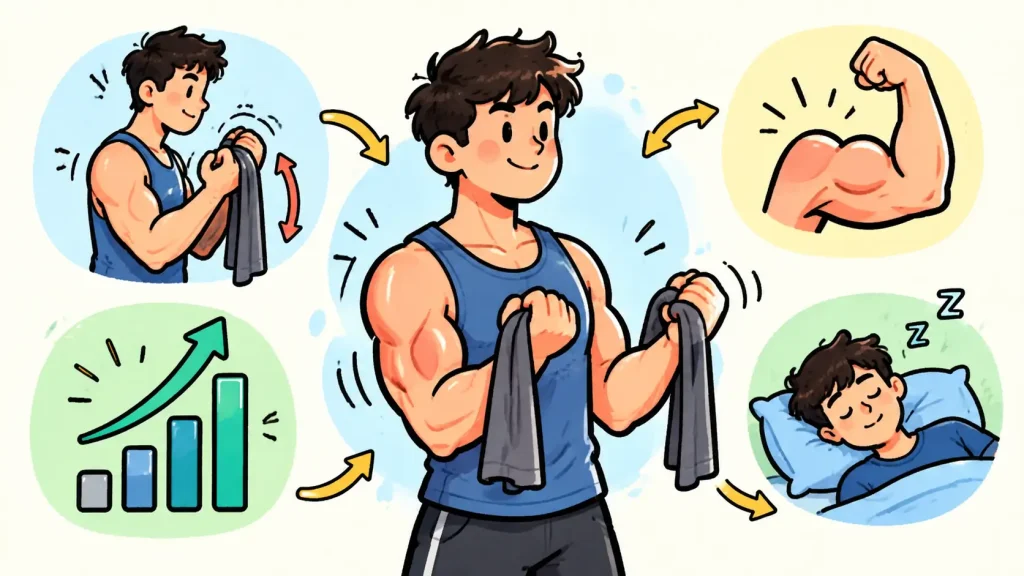
2. Towel Curls
A genuinely clever way to simulate a curl. All you need is a sturdy towel.
- Stand on one end of the towel with your foot.
- Grip the other end and curl toward your shoulder, using your foot as anchor.
- Control the tension the whole way up and down.
Your foot pressure adjusts the resistance level. Press harder for more challenge.
3. Doorway Curls
This one uses an isometric hold against a fixed object. It builds real tension without any movement.
- Stand in a doorway and grip the frame at waist height.
- Pull upward against the frame as hard as you can, holding 15-30 seconds.
- Repeat for 3-4 sets, resting 30 seconds between.
4. Backpack Curls
If you have a backpack and some books, you’ve got a makeshift dumbbell. Water bottles or canned food work too.
- Load a backpack with weight that challenges you by rep 10-12.
- Hold one strap in each hand, or loop both together for a heavier option.
- Perform standard curls, keeping elbows tucked at your sides.
5. Isometric Bicep Holds
No equipment needed at all here. Just your own resistance against itself.
- Bend one arm to 90 degrees, then push down against your wrist with the other hand.
- Resist the push with your bicep for 10-15 seconds without letting your arm move.
- Switch arms and repeat for 3-4 rounds each side.
6. Table Rows
An underrated move that hits biceps and back together. This builds pulling strength efficiently.
- Lie underneath a sturdy table, gripping the edge with an underhand grip.
- Keep your body straight and pull your chest toward the table edge.
- Lower slowly and repeat for 10-15 reps.
Make sure the table can hold your weight first. Test it with a firm push before committing.
Sample Bodyweight Bicep Workout
Here’s a simple bodyweight bicep workout you can run two to three times a week.. Rest at least one day between sessions.
- Chin-ups (or assisted negatives): 3 sets to near failure
- Towel curls: 3 sets of 12-15 per arm
- Doorway curl holds: 3 sets of 20-30 seconds
- Table rows: 3 sets of 12-15 reps
- Isometric bicep holds: 2 sets of 15 seconds per arm
Rest 45-60 seconds between sets. If chin-ups feel too easy by week three, slow down your reps instead.
Adding extra rounds works too, rather than rushing through sets. Track your numbers from week to week, even loosely.
Writing down “did 5 chin-ups, felt hard by rep 4” helps. Comparing that to “did 7 chin-ups” a month later proves progress. This matters a lot for staying motivated over time.
Consistency beats intensity in the early weeks. Two solid sessions weekly outperform one brutal, sporadic workout. Building the habit first makes the strength gains stick.
How to Build Bigger Arms Without Weights
Building visible arm size without dumbbells follows a few principles. No single miracle exercise does it alone.
Progressive overload still applies. Even without weights, you can add reps. Slow down the tempo or increase time under tension.
Control the eccentric phase. Lowering slowly under control, 2-3 seconds, recruits more muscle fibers. This beats dropping quickly every time.
Train to near failure, not just a set number. The last few shaky reps often trigger the most growth. Form breakdown signals you’ve pushed hard enough.
Don’t skip recovery. Muscles grow during rest, not during the workout. Two to three sessions weekly beats daily training that never recovers.
One thing worth being honest about: matching heavy barbell size gets harder as you advance. For beginners and intermediate lifters, though, the gap stays smaller than people assume.
It’s also worth pairing bicep work with tricep exercises. Balanced arm development looks better and reduces injury risk. Overtraining one side of the joint causes problems.
Close-grip push-ups and bench dips both hit the triceps hard. No equipment is needed for either move. Alternating bicep and tricep focus keeps the whole arm developing evenly.
Common Mistakes to Avoid
Using momentum instead of muscle.
Swinging your body during chin-ups or curls shifts work away from the biceps.
Skipping the eccentric portion.
Dropping down fast from a chin-up wastes half the benefit. Slow negatives matter more than people realize.
Training biceps without training your back.
Rows and pull-based moves support long-term bicep growth. They strengthen the muscles around your biceps too.
Expecting fast results.
Visible arm changes typically take 6-8 weeks of consistent training. Patience matters more than intensity here.
Neglecting nutrition entirely.
Muscle growth needs enough protein and overall calories. No workout routine gets around that requirement.
It’s easy to get discouraged if arms look the same after two weeks. Strength gains almost always show up before visible size does. Track your reps rather than only checking the mirror.
FAQ
Can you actually build bicep size with just bodyweight exercises?
Yes, especially for beginners and intermediate lifters. Chin-ups, towel curls, and slow eccentric training all stimulate real growth.
How often should I train my biceps with bodyweight exercises?
Two to three times a week works well for most people. Leave at least one rest day between sessions.
Do I need a pull-up bar for bodyweight bicep exercises?
No. Doorway curls, towel curls, and isometric holds all build strength. None of them require a bar.
Can resistance bands help alongside bodyweight training?
Yes, though they’re technically equipment. A cheap band adds adjustable tension to curls and rows, without dumbbell costs.
How long until I see results from bodyweight bicep training?
Most people notice strength improvements within 2-3 weeks. Visible size changes typically follow within 6-8 weeks.
Are chin-ups better than curls for biceps?
Chin-ups engage more muscle overall and build functional strength. Curls isolate the bicep more directly. Combining both works best.
The Bottom Line
Bodyweight bicep exercises won’t replace a fully loaded barbell forever. But they can absolutely build real strength and noticeable size. This is especially true if you’re just getting started.
Stick with chin-ups, towel curls, and consistent progressive overload. Your arms will respond over time.