Resume Skills List: 30 Valuable Skills That Get You Hired
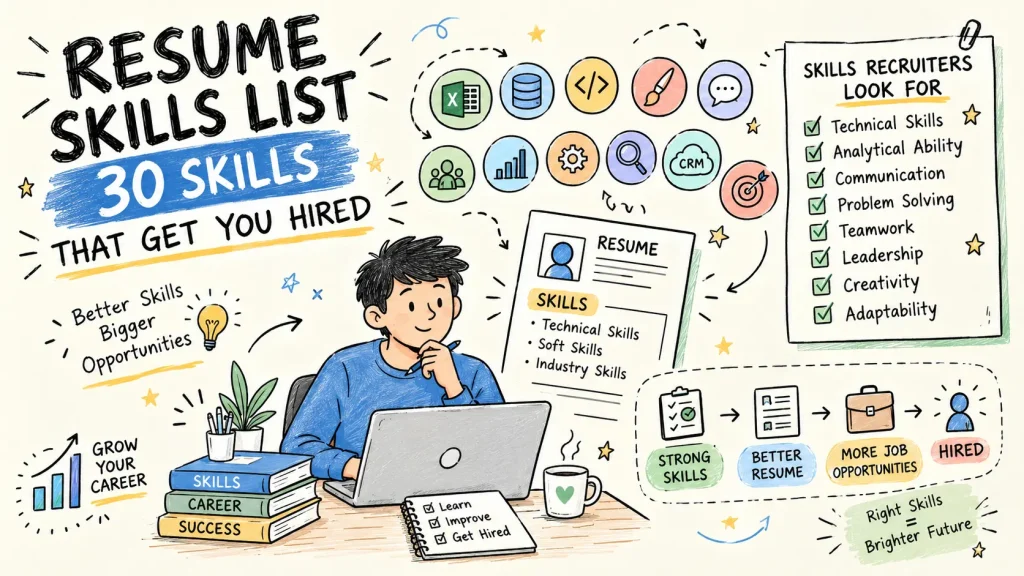
A strong resume skills list combines hard skills and soft skills. Hard skills are technical abilities specific to a job. Soft skills show how you work with others.
The best skills to put on a resume match the job you want. Recruiters scan resumes for only 6 to 7 seconds on average. Your skills section can determine whether they keep reading.
Avoid listing every skill in a large block of text. Also avoid vague terms such as “hardworking.” These approaches may not impress applicant tracking systems or recruiters.
This guide includes 30 resume skills organized by category. You will also learn how to choose the right skills for your resume.
Why Your Skills Section Matters More Than You Think
Most applicant tracking systems (ATS) scan resumes for keywords. This happens before a person ever sees them. If your skills section doesn’t match the posting, you get filtered out.
This happens even with strong experience behind it. The fix is simple, though. Read the job description closely and mirror its exact terms.
If they say “project management,” don’t write “managing projects.” Small wording differences can trip up keyword matching. Say a posting lists “cross-functional collaboration” as a requirement.
If your resume says “worked well with other teams,” an ATS might miss it. Even though you clearly have the skill, the exact phrase matters. Copying the posting’s language closes that gap.
Only do this when it’s honestly true of your experience. Don’t stretch the truth just to match a keyword. ATS software isn’t just counting keywords once, either.
Many systems rank resumes by how often a term appears. They also track where it shows up on the page. A skill mentioned once, buried at the bottom, carries less weight.
Compare that to a skill in your summary and skills section. Then it appears again inside a bullet point. That’s under your most recent job entry.
Building Your Hard Skills List
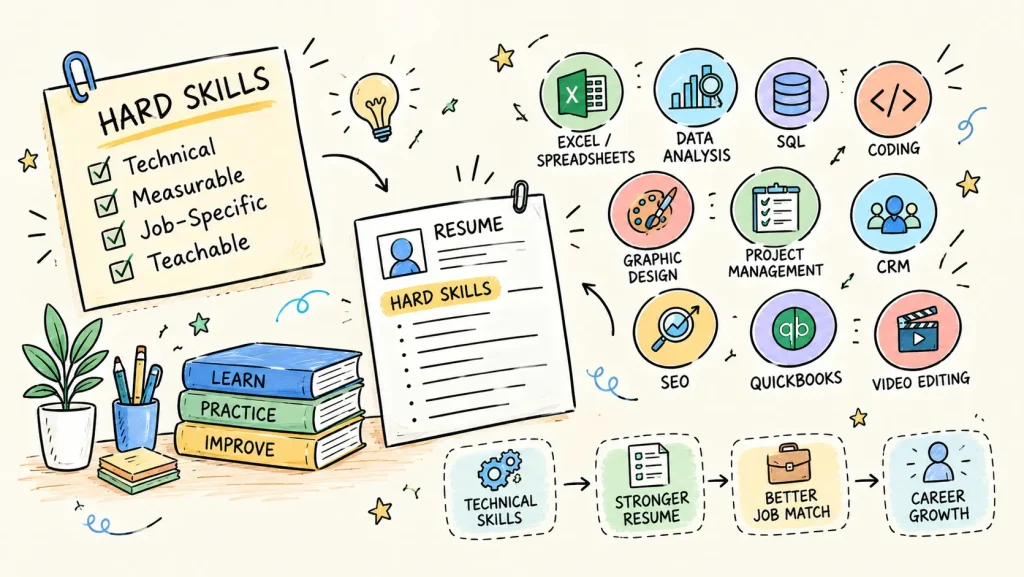
Hard skills are teachable, measurable abilities tied to a job. ATS software tends to hunt for these first. A good resume skills list always leads with these.
Technical & Software Skills
- Microsoft Excel (or Google Sheets) – still one of the most requested skills across finance, admin, and operations roles.
- Data analysis – pulling insights from numbers, whether in marketing, sales, or research.
- SQL – querying databases, useful well beyond just tech jobs now.
- Graphic design software (Adobe Creative Suite, Canva) – relevant for marketing, content, and design roles.
- Project management tools (Asana, Trello, Monday.com) – shows you can organize and track work.
- CRM software (Salesforce, HubSpot) – a must for sales and customer-facing roles.
- Basic coding (HTML, Python, JavaScript) – increasingly expected even outside dedicated developer jobs.
- Social media management – running accounts, scheduling content, tracking engagement.
- Bookkeeping/accounting software (QuickBooks) – valuable for finance and small business roles.
- Video editing – a growing ask as companies invest in content marketing.
Industry-Specific Skills
- Inventory management – common in retail, warehousing, and logistics.
- Medical terminology – expected in healthcare admin and clinical support roles.
- Copywriting – persuasive, clear writing for marketing and sales content.
- Budgeting and forecasting – a finance and operations staple.
- UX/UI design – how usable and intuitive a product feels to users.
- Search engine optimization (SEO) – getting content to rank in search results.
- Regulatory compliance – knowing the rules that govern your industry.
- Technical writing – turning complex processes into clear documentation.
- Sales forecasting – predicting revenue based on trends and pipeline data.
- Foreign language proficiency – genuinely useful in customer-facing and global roles.
Building Your Soft Skills List
Soft skills are harder to measure but just as important. They show how you actually work day to day. The trick is backing them up with proof.
- Communication – writing and speaking clearly, whether in an email or a meeting.
- Problem-solving – figuring out solutions when things don’t go as planned.
- Adaptability – handling change without losing momentum.
- Time management – juggling deadlines without dropping the ball.
- Leadership – guiding a team or project, even without a formal title.
- Collaboration – working well across departments and personalities.
- Critical thinking – weighing options and making sound decisions under pressure.
- Attention to detail – catching errors before they become expensive mistakes.
- Conflict resolution – de-escalating disagreements and finding middle ground.
- Emotional intelligence – reading a room and responding with the right tone.
Don’t just list “leadership” and move on. Instead, tuck it into an accomplishment. Try something like “led a five-person team through a launch.”
Say it came two weeks ahead of schedule. That one line does more work. It beats the bare word every time.
How to Choose the Right Skills for Your Resume
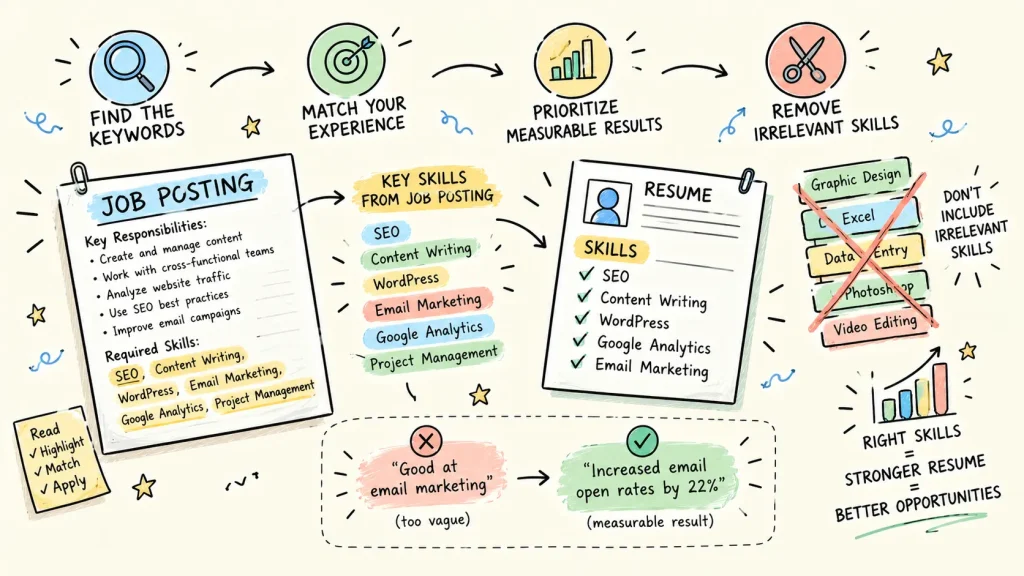
You don’t need all 30 skills to put on a resume. Cramming in everything usually backfires. It reads as unfocused and dilutes what matters.
Start with the job posting itself. Highlight every skill word mentioned there. Match your resume to genuine ones only.
This step shapes most of your final list. Prioritize what’s measurable over vague claims. “Increased email open rates by 22%” beats “good at email marketing.”
Balance hard and soft skills, too. An all-technical resume can feel robotic. An all-soft-skills resume can feel vague.
Cut anything outdated from the page. Skills like “Microsoft Word” are assumed now. They just take up valuable space.
One thing worth mentioning here: don’t copy generic lists. It’s tempting to paste one straight onto your resume. Hiring managers review hundreds of applications weekly.
They notice when the same skills repeat everywhere. A resume echoing the job posting looks tailored. One that reads like a template looks generic.
Think in terms of proof, not labels. For every skill, ask yourself one thing. Could I describe a moment I used this?
If the honest answer is no, skip it. It probably doesn’t belong on the page yet. This applies no matter how good it sounds.
Where to Put Skills on Your Resume
A dedicated skills section works well for scanning. Place it near the top or side. But don’t stop there entirely.
Weave your strongest skills into work experience bullets too. That’s where they actually get proven. Some resumes also use “Core Competencies” sections.
This sits right under your summary line. It’s a short row of 6-8 keyword phrases. That catches both the ATS and recruiters fast.
Formatting matters here too, honestly. A cluttered section with 25 items signals poor selectivity. It also buries the two or three skills that matter most.
Grouping skills into short categories helps a lot. Try “Technical Skills” and “Leadership & Communication” as headers. This reads cleaner than one long list.
It’s a small change with a big payoff. It makes your resume skills list easier to scan. Recruiters notice that difference immediately.
If you apply across different role types, prepare accordingly. Keep two or three versions of your skills section ready. A project coordinator list differs from a data analyst list.
This holds true even with overlapping abilities between roles. Swapping in the right version takes minutes. It noticeably improves your match rate for each job.
FAQ
What are the top 5 skills employers look for on a resume?
Communication, problem-solving, adaptability, teamwork, and technical proficiency rank highest. These consistently top requirements across most industries and job types.
Should I list skills I’m still learning?
Only if you can discuss them in an interview. Listing skills you can’t back up backfires fast.
How many skills should I put on a resume? Somewhere between 8 and 15 is typical. It depends on your industry and experience section length.
Do soft skills matter as much as hard skills?
Yes, especially for teamwork, client interaction, or leadership roles. Soft skills often separate similarly qualified candidates from each other.
Should my skills list change for every job application?
Ideally, yes. Tailoring your list improves your odds with both ATS software and human reviewers.
The Bottom Line
A resume skills list works when it’s specific and current. It also needs to match the job in front of you. Pick skills that are actually true.
Back them up with real examples always. Skip the filler words everyone else uses. Specificity beats generic buzzwords every single time.