What Is the Benefit of a Savings Account? 7 Reasons to Save
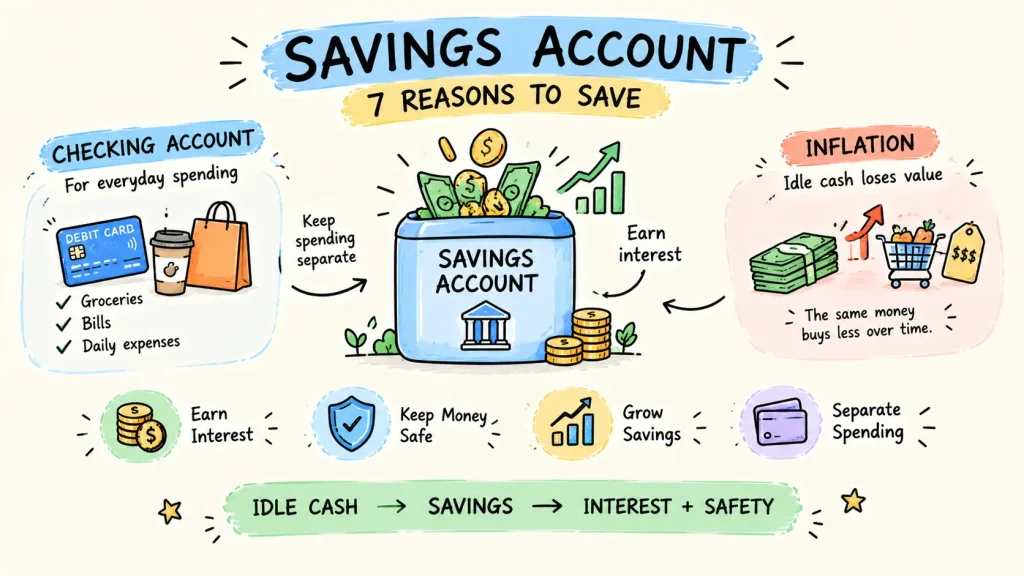
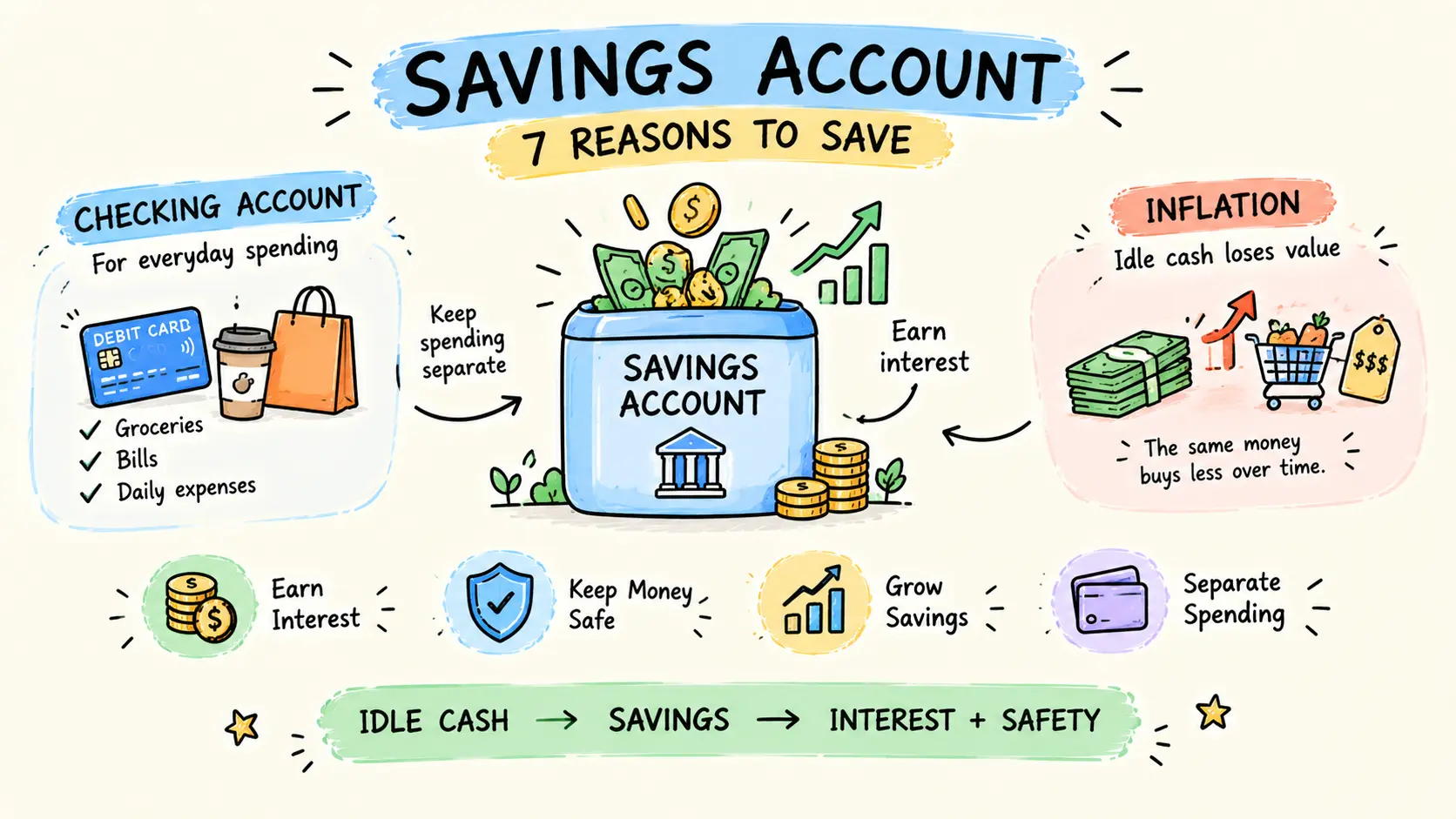
Leaving cash in a checking account earns you nothing while inflation quietly eats its value. A savings account fixes that by paying interest, keeping your money safe, and separating it from the funds you spend day to day. Understanding what is the benefit of a savings account starts with one simple fact: it’s the easiest way to make idle money work a little harder without any risk.
This article is for general information only and isn’t personalized financial advice. Talk to a bank representative or financial advisor before making decisions about your own accounts.
1. Your Money Actually Earns Something
A regular checking account typically pays 0% interest. A savings account, even a basic one at a traditional bank, pays something – and high-yield savings accounts often pay significantly more, sometimes many times the national average rate. Over a year, that difference adds up, especially once your balance grows past a few thousand dollars.
This is the most obvious answer to what is the benefit of a savings account, but it’s easy to underestimate. On $5,000, the gap between 0% and a competitive rate can mean over $100 a year in free money, just for choosing the right account. That’s not life-changing on its own, but it’s money you’d otherwise leave on the table for doing absolutely nothing extra.
The rate also matters more than people assume. Two savings accounts can look nearly identical on the surface – same FDIC insurance, same basic features – while paying very different interest. Comparing rates before opening an account, or moving money to a better one, costs almost no effort and has no downside.
2. It’s Federally Insured, So Your Money Is Safe
Savings accounts at banks insured by the FDIC are protected up to $250,000 per depositor, per bank. Credit unions offer similar protection through the NCUA. That means even if the bank fails, your money doesn’t disappear – the insurance covers your balance up to that limit, no questions asked.
This is a real advantage over keeping large sums in cash at home or in riskier places like a brokerage account, where the value can fall. A savings account won’t lose principal from market swings – the balance you deposit is the balance that stays, plus interest. Cash under a mattress can be lost, stolen, or damaged, and it earns nothing while it sits there.
For anyone nervous about market volatility, this safety net is often the deciding factor. You’re trading a lower potential return for near-total certainty that your money will still be there when you need it. For short-term savings and emergency funds, that trade-off usually makes sense.
3. It Creates Distance Between “Spending Money” and “Saving Money”
One of the quiet psychological benefits of a savings account is separation. If your savings are in the same account as your groceries and bills, it’s easy to dip into them without even realizing it. Having a separate account – particularly one at a different bank than your checking account – introduces just enough friction to prevent impulse spending.
You’ll notice this matters more than it sounds like it should. People who keep savings and spending money physically separated tend to preserve their balances better than people who mix the two, simply because the extra step of transferring money forces a moment of reconsideration. That short pause is often enough to talk yourself out of an unnecessary purchase.
This separation also makes it easier to track progress. When your savings balance is its own number, in its own account, you can see clearly whether you’re moving toward a goal or standing still. Mixed together with checking, that clarity disappears.
4. You Get Fast Access in an Emergency
Your money isn’t locked up in a savings account like it is with a certificate of deposit (CD) or an investment account. Most banks will allow you to transfer money to checking or withdraw cash within a day or two, sometimes immediately if the accounts are linked.
That combination – safety plus quick access – is exactly what an emergency fund needs. A medical bill, a car repair, or a sudden job loss doesn’t wait for a 90-day CD to mature. Financial counselors often suggest saving enough to support three to six months of vital expenses in an account that’s easy to access – and a savings account fits the bill.
Think of an investment account, where taking money out during a market slump could mean selling at a loss. A savings account takes care of that problem entirely. The money is there, it’s safe and you don’t have to make a bad financial choice just because you need cash fast.
5. It Helps You Build Toward Specific Goalsy
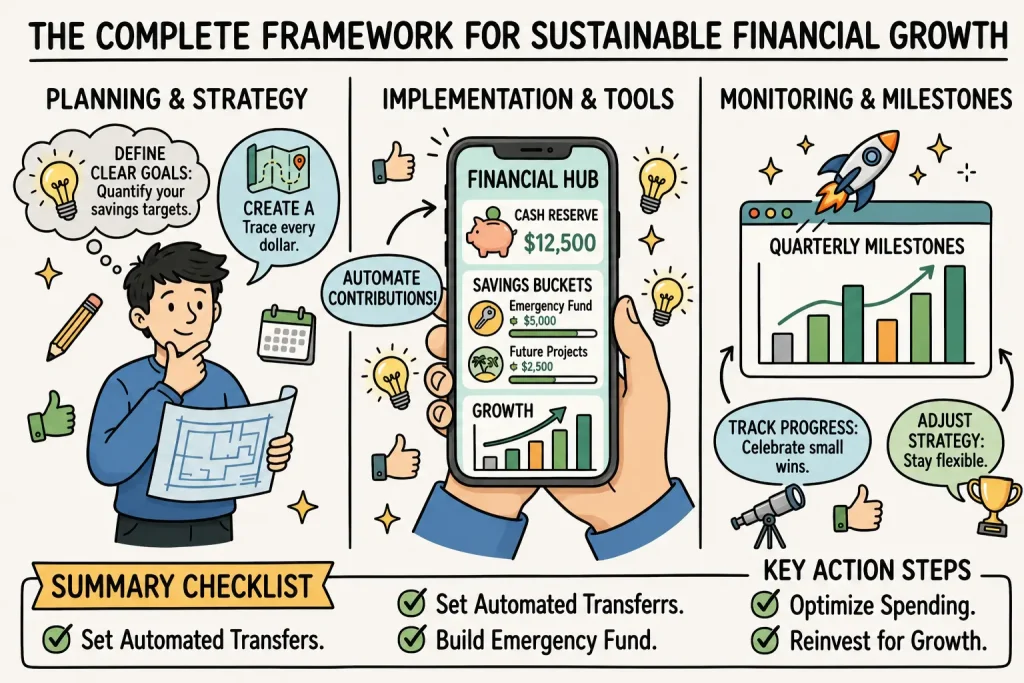
A savings account isn’t just a place to stash cash; it’s a tool for planning. A lot of banks allow you to create many sub-accounts, or “buckets,” so you can save for a vacation, down payment, or holiday budget separately without the amounts blending together.
Watching a labeled goal grow tends to keep people more motivated than watching one generic balance climb. If you’re saving for a $2,000 trip, seeing “Trip Fund: $840” is a clearer signal of progress than a lump sum you’d have to do mental math on. It also prevents accidentally spending your down payment money on something else, because it’s mentally – and often literally – set aside.
This type of goal-oriented saving is especially good for people who struggle with fuzzy goals like “save more this year.”“A number, with a specific purpose, gives you something concrete to work towards and measure.
6. Interest Compounds, So Growth Speeds Up Over Time
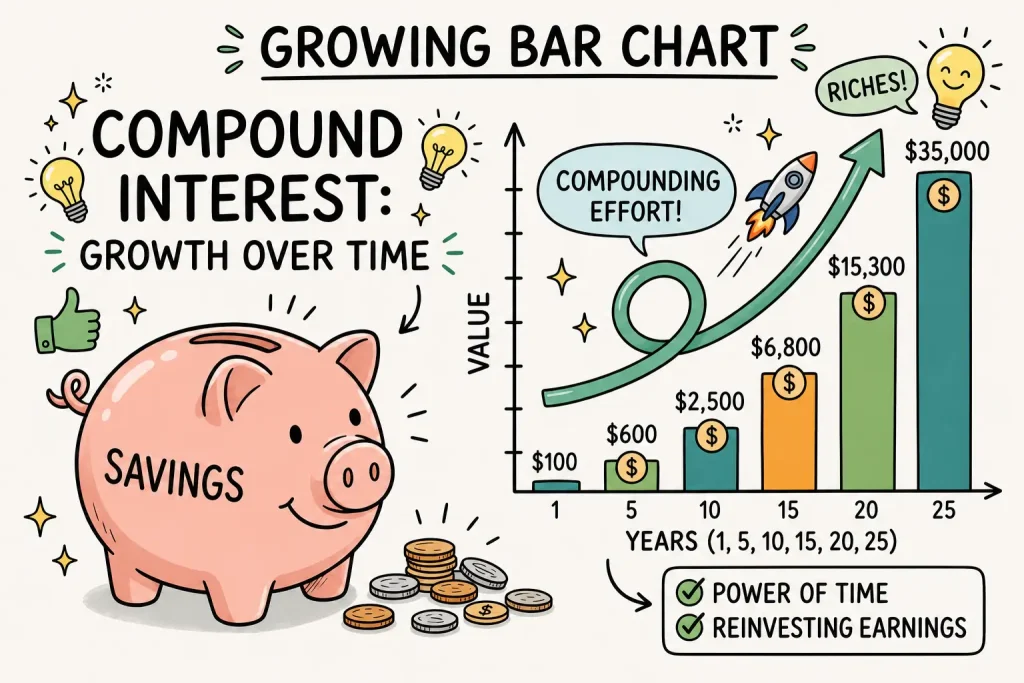
Most savings accounts use compound interest, meaning you earn interest not just on your original deposit but on the interest that’s already accumulated. It’s a small effect at first and a bigger one the longer the money sits.
This is part of why starting early matters more than starting with a large amount. A modest, consistent deposit into an account with compound interest, left alone for years, often outperforms a single larger deposit made later – not because of luck, but because of time. The earlier the money starts compounding, the more time it has to build on itself.
Many banks compound interest daily or monthly rather than just once a year, which means the effect adds up faster than a simple annual rate might suggest. Checking how often your bank compounds interest is worth the two minutes it takes to look up.
7. It Encourages a Habit of Saving
Saving becomes a habit, not a monthly decision, with automatic transfers to a savings account. Money is saved before you have a chance to spend it once the transfer is automated.
This ties back to broader budgeting fundamentals – a savings account works best as part of a system, not a one-time setup. Pairing it with a simple saving tips guide can help you decide how much to automate each month based on your actual expenses.
Automation also removes the willpower problem. You don’t have to remember to save, and you don’t have to talk yourself into it every payday. The habit builds itself in the background, and most people barely notice the money leaving once the transfer becomes routine.
Frequently Asked Questions
What is the benefit of a savings account if I only have a small balance?
Even a small balance benefits from FDIC insurance, separation from spending money, and the habit-building effect of watching it grow. The interest earned will be modest, but the safety and structure still apply regardless of balance size.
Is a savings account worth it with only $300?
Yes – the point isn’t necessarily the interest at that balance, it’s building the habit and having a safe, accessible place for money you don’t want to spend right away. Many high-yield accounts have no minimum balance requirement.
How is a savings account different from a checking account?
Checking accounts are built for frequent transactions like debit card purchases and bill pay, usually with no interest. Savings accounts are built to hold money longer term and typically pay interest, though some limit the number of withdrawals per month.
Do savings accounts lose value to inflation?
If the interest rate is lower than the inflation rate, the purchasing power of your savings can still decline slowly, even though the dollar amount grows. This is why some people split long-term savings between a savings account and other options once their emergency fund is established.
Can I lose money in a savings account?
Your principal is protected at FDIC-insured banks up to $250,000, so you won’t lose money the way you could in the stock market. The main “cost” is opportunity cost – money in savings usually grows slower than money invested over the long run.
The Bottom Line
The real benefit of a savings account isn’t one single feature – it’s the combination of safety, easy access, and steady, if modest, growth that makes it the right home for money you’re not ready to spend or invest. If you don’t already have one working for your emergency fund or a specific goal, opening a high-yield savings account this week is a concrete first step.
This article is for informational purposes only and isn’t professional financial advice.